
For a long time, I lived under a heavy cloud. If you looked at my life from the outside, you might have seen a kind person, someone who tried their best. But if you looked at my wallet, or more importantly, at my heart when I opened my wallet, you would have seen a storm.
Since I was young, money and I were like oil and water—we just didn’t mix. While my friends were joyfully planning vacations, buying their dream cars, and securing property, I was standing on the sidelines, wondering what secret password I had missed.
I wasn’t just “broke.” I was heartbroken by my own finances.
There were times my salary was so meager that if I offered it to a beggar, he might have handed it back to me out of pity. Sometimes, I wouldn’t be paid fully for my hard work. Sometimes, I wouldn’t be paid at all. I lived in a constant state of “Why?”
Why me? Why is it always me? Why is it only me?
The stress wasn’t just in my head; it was in my body. I was drowning in debt, depressed, and convinced that the anxiety was going to make me physically sick. I eventually gave up. I told myself, “Money just isn’t for people like me.”
The Paradox of the “Cheerful Giver
“Here is where the story gets interesting, and where I misunderstood the flow of life for so long.
I always thought of myself as a generous person. And I was! When I saw someone in need, I gave. I was a “cheerful giver” to the poor. I gave with an open heart, and I felt close to God when I did it. I thought this meant my “money energy” was good.
But I had a blind spot.
I was a cheerful giver to the needy, but I was a resentful giver to my bills.
Every time I had to pay a debt, cover the rent, or pay a utility bill,taxes my heart closed tight. I paid them, but I paid them with anger, fear, and frustration. I felt like that money was being “taken” from me. I was sending that money out into the world wrapped in negative energy.
The Gentle Realization
Then, I found Happy Money by Ken Honda. As I read his gentle words, I realized that money is just energy—it is a flow, like water. You cannot ask the water to flow only in the parts of the river you like and stop in the parts you dislike.
Ken Honda taught me that my mistake wasn’t about how much I had; it was about how I felt when it left my hands.
I realized I wasn’t being thankful to God for the entire cycle. I was only thankful for the parts that made me feel like a hero (charity), not the parts that made me feel responsible (bills).
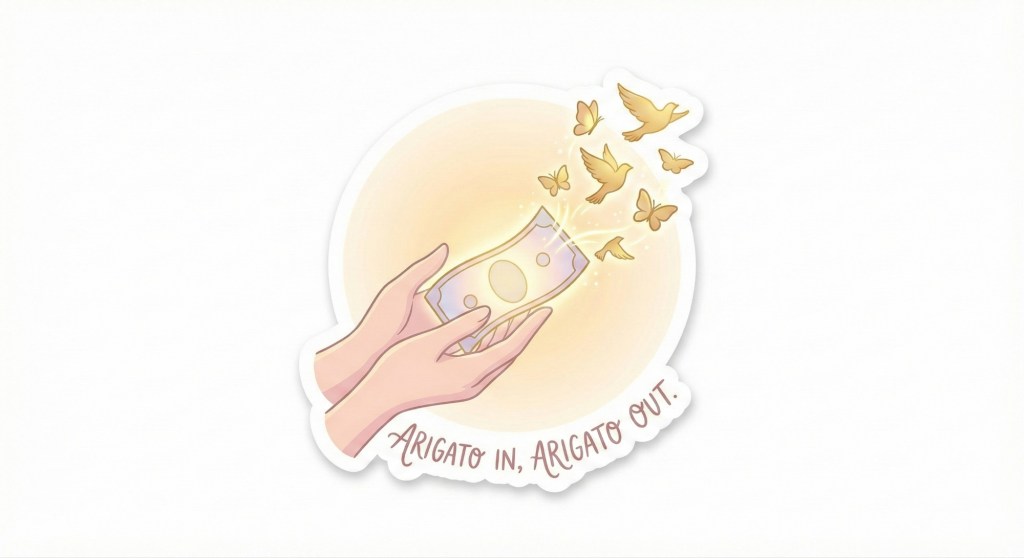
Arigato In, Arigato Out
I learned that paying a bill is actually a beautiful thing. It is a way of saying “Thank you” for a service received.
When I pay the electric bill, I am saying, “Thank you for the light that keeps my home warm.”
When I pay a debt, I am saying, “Thank you for trusting me when I needed help.”
By resenting my bills, I was cursing the very support system that was keeping me alive.
A Message to You
If you are reading this, and you feel like the world has forgotten you, please know that I see you. I have been you.
I want to encourage you to try something different. It is not about working harder or forcing luck to change. It is about softening your heart toward the money you do have.
When you pay a bill today, do not sigh. Do not worry about what is left. Instead, take a deep breath, look at the money (or the screen), and whisper, “Arigato. Thank you. Go and bless someone else now.”
Since I made this shift, the heavy sickness in my chest has lifted. The “Why me?” has turned into “Thank you, God.” I may not be driving a luxury car yet, but I am driving my life with peace. And that, my friends, is true wealth.
 Explorers Lens: The Global Exploration Magazine