A Legacy Of Explorers: Delving Into Shell Grotto’s Mysteries
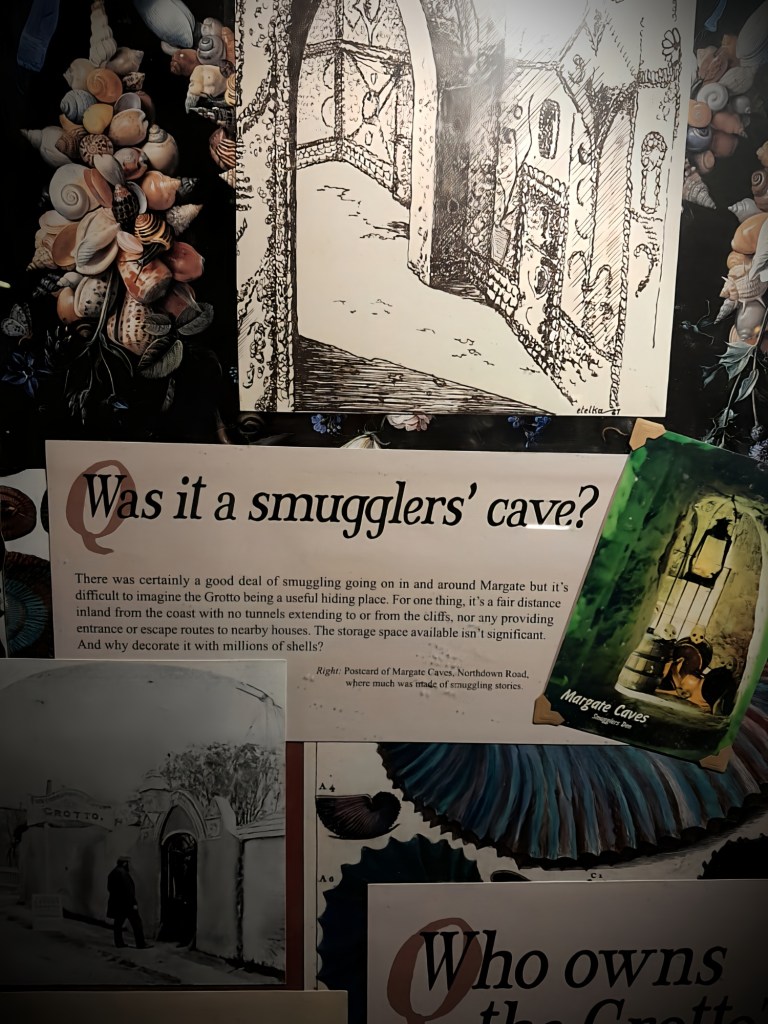
Five degrees Celsius and a biting wind – not your typical mid-December, especially in the usually mild Margate. The air was filled with the scent of pine and a faint hint of cinnamon, a reminder that Christmas was just around the corner. But with my curious 8-year-old son, Jaden, in tow, even the frosty weather couldn’t dampen our spirits. We were on a mission to explore the enigmatic Shell Grotto, a subterranean cave shrouded in mystery. ”Imagine a secret passage leading to a chamber encrusted with millions of shimmering shells! ‘I said to Jaden. That’s the Shell Grotto, a place that has baffled people for nearly two centuries. No one knows who built it, why they built it, or even how they managed to create such intricate mosaics in complete darkness. Some say it was a prehistoric temple, and others whisper secret societies.
Jaden, my little explorer, has inherited the adventurous streak that runs deep in our family. It’s a legacy passed down from our ancestors who, generations ago, braved the unknown to forge new lives. Today, we follow in their footsteps, eager to uncover the secrets hidden within this underground world. Just like a young boy named Joshua, who stumbled upon this grotto back in the 1800s. Can you imagine, Jaden, being the first person to see this incredible sight?
My excitement had kept me up late the night before, pouring over articles and historical accounts of the Grotto. Armed with a mix of facts and intriguing theories, I was ready to share this adventure with my son. As we hopped on the loop bus to Margate, I recounted the tales of our ancestors who had braved perilous seas to journey from India to Mauritius in the early 1800s. Jaden, wide-eyed with wonder, absorbed every detail, his own adventurous spirit ignited. The bus ride was a pleasant interlude to our exploration, filled with anticipation and shared excitement.
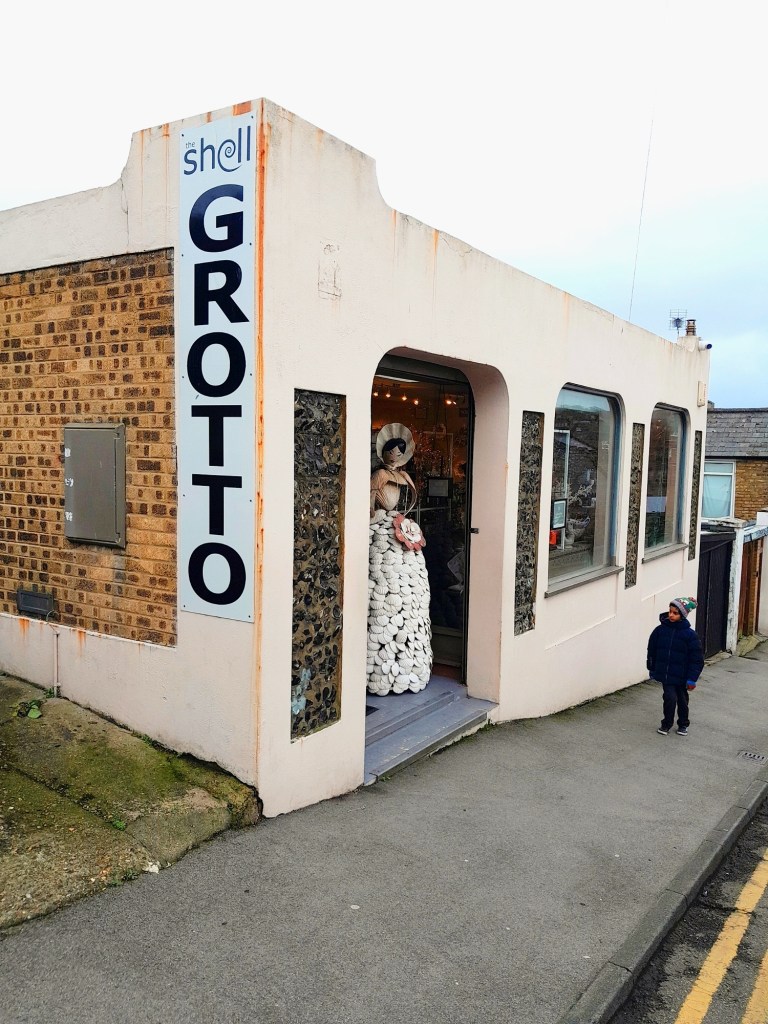
The wind whipped through the narrow, historic streets of Margate as we made our way to the Shell Grotto museum. The once-grand houses, now weathered and worn, bore the marks of time. Some were adorned with festive decorations, a stark contrast to the sombre grey sky. Christmas trees, their lights twinkling brightly, offered glimpses of warmth through dusty windows. Yet, the overall atmosphere was one of quiet melancholy. The streets were nearly deserted, save for a few hurried passers-by and the occasional car. Jaden, whose excitement had been palpable earlier, seemed subdued by the bleak scene.
Yet, despite the veil of melancholy that hung over the coastal town, its unique charm beckoned like a hidden treasure. The invigorating coastal breeze, carrying the scent of salt and sea, caressed our cheeks, reminding us of the town’s enduring connection to the sea. Even the weathered houses, with the faded grandeur, possessed a certain character, whispering stories of bygone era. And the people, despite the chill in the air, were warm and welcoming. When we paused, momentarily lost in the maze of streets, friendly locals readily offered directions to the museum, their kindness adding a touch of warmth to the otherwise grey day. Margate, with its blend of faded elegance and genuine hospitality, was slowly revealing its hidden heart.
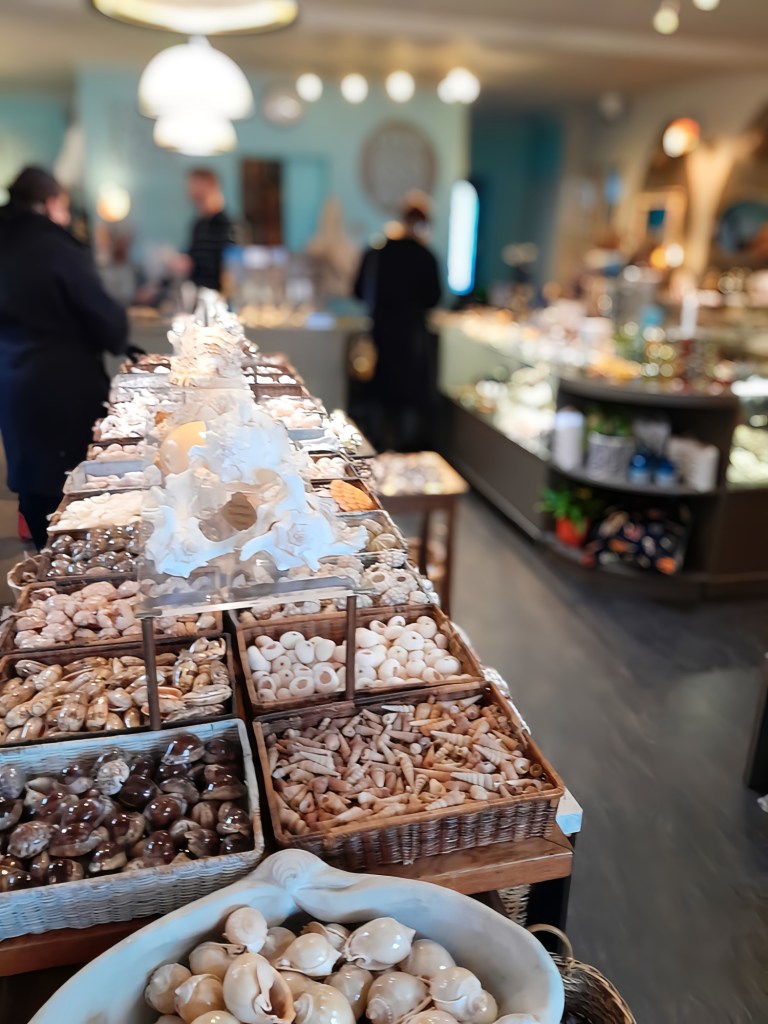
Stepping through the museum doors, we were greeted by a comforting warmth and the hushed whispers of history. The gloom of the streets seemed to melt away as we immersed ourselves in the exhibits, each artefact a piece of a puzzle waiting to be solved. The museum itself was a treasure trove of wonders, with displays showcasing the diversity and beauty of shells from around the coastal beaches of southeast Kent.
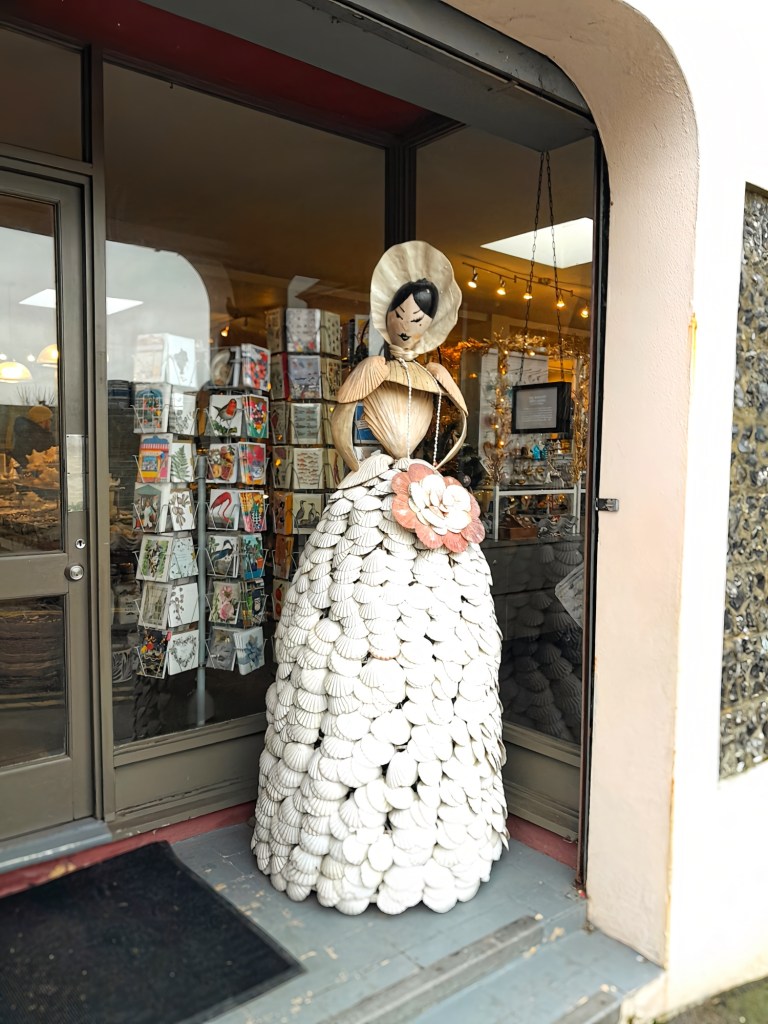
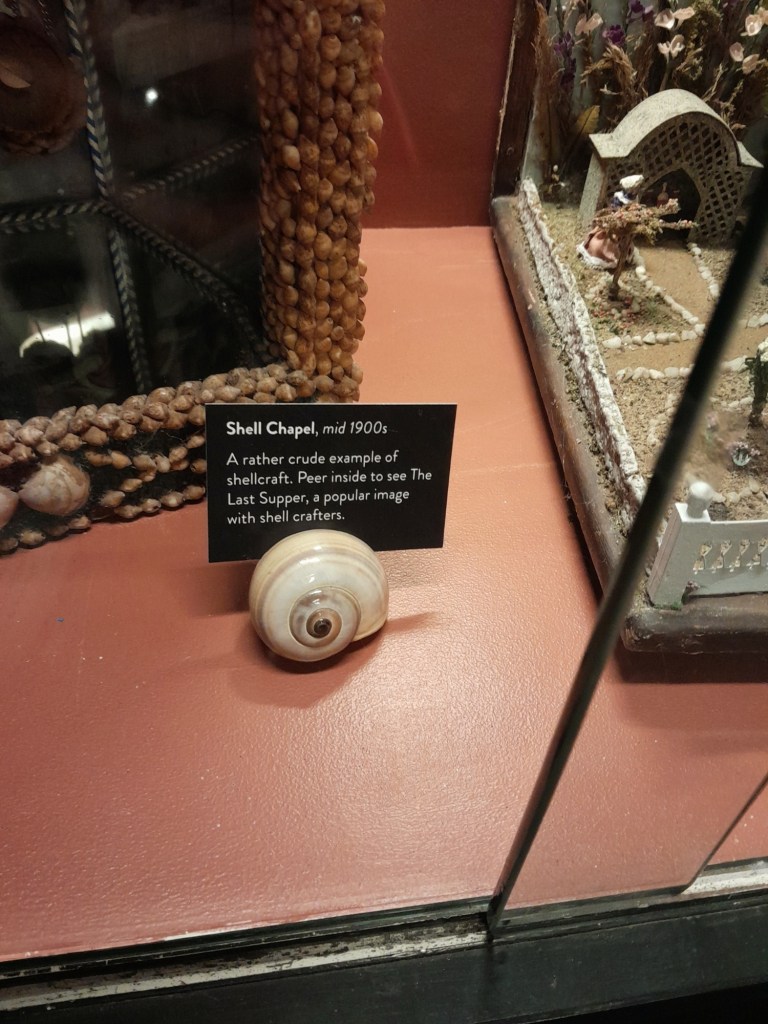
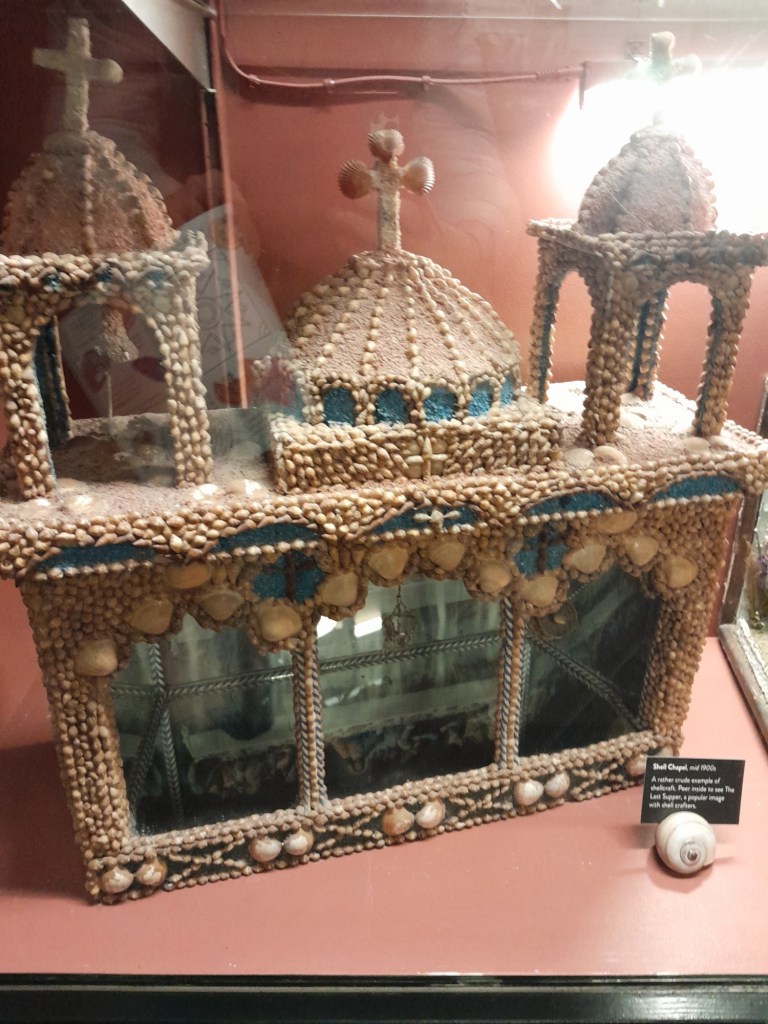
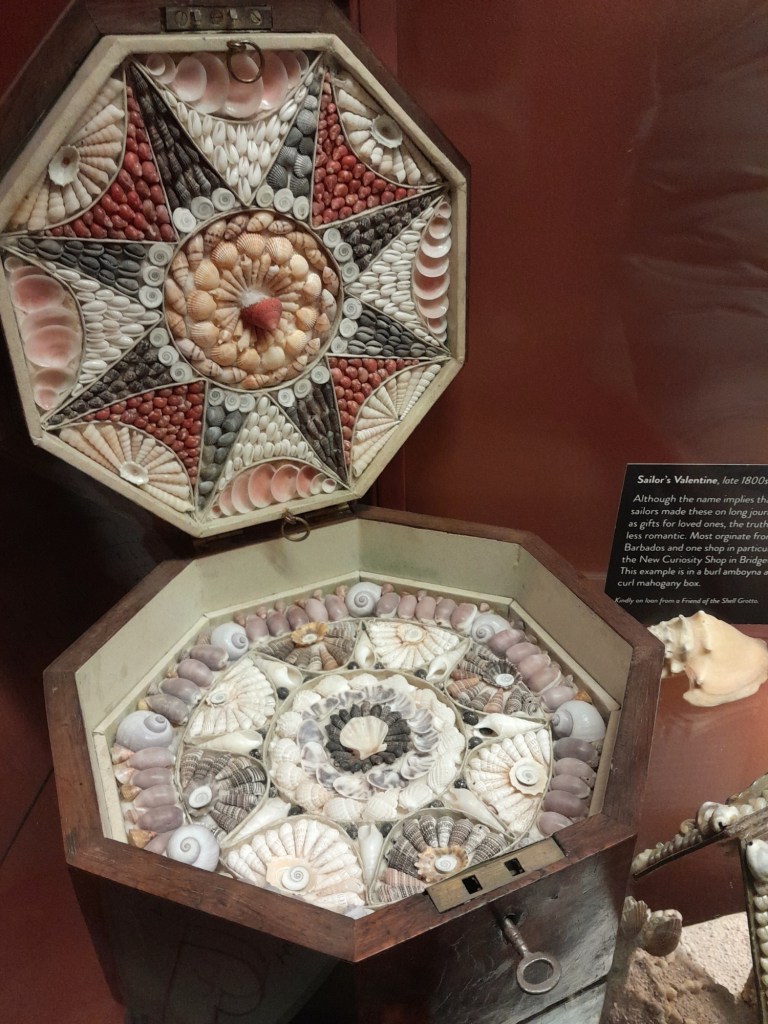
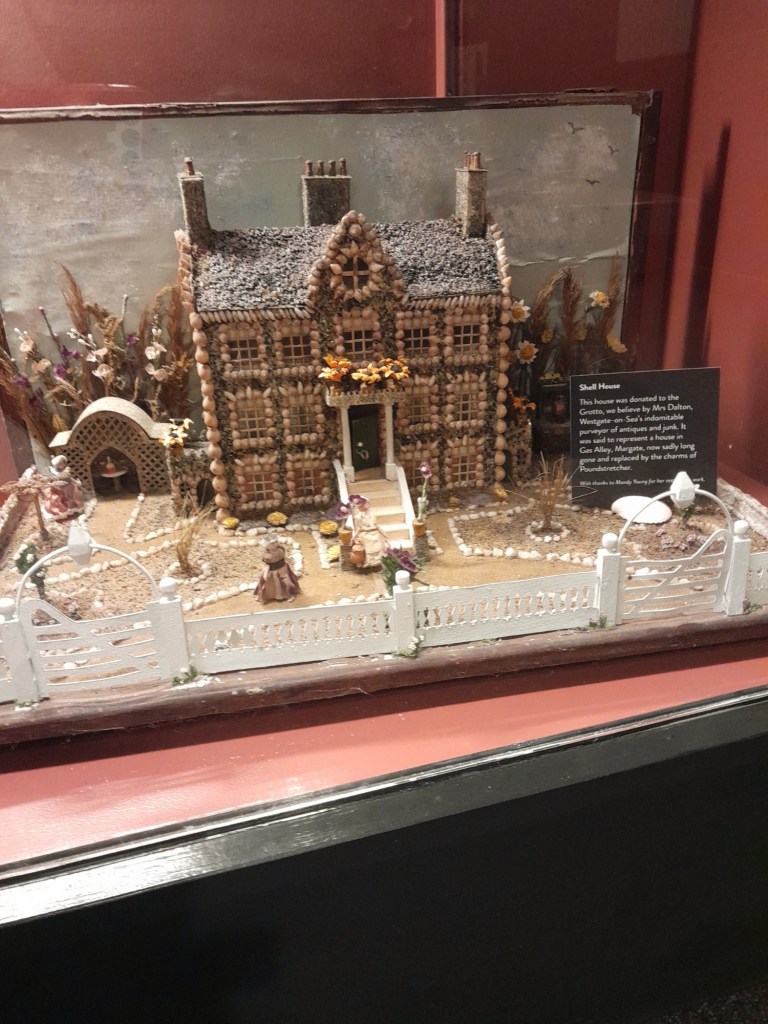
One table, laden with baskets overflowing with shells of every shape, size and color imaginable, caught our attention. It was like a miniature seaside market, each shell whispering its own story of ocean voyages and hidden depths. A display showcased the artistry and craftsmanship inspired by these natural wonders. Delicate shell mosaics, meticulously crafted into intricate patterns, adorned decorative boxes and ornaments
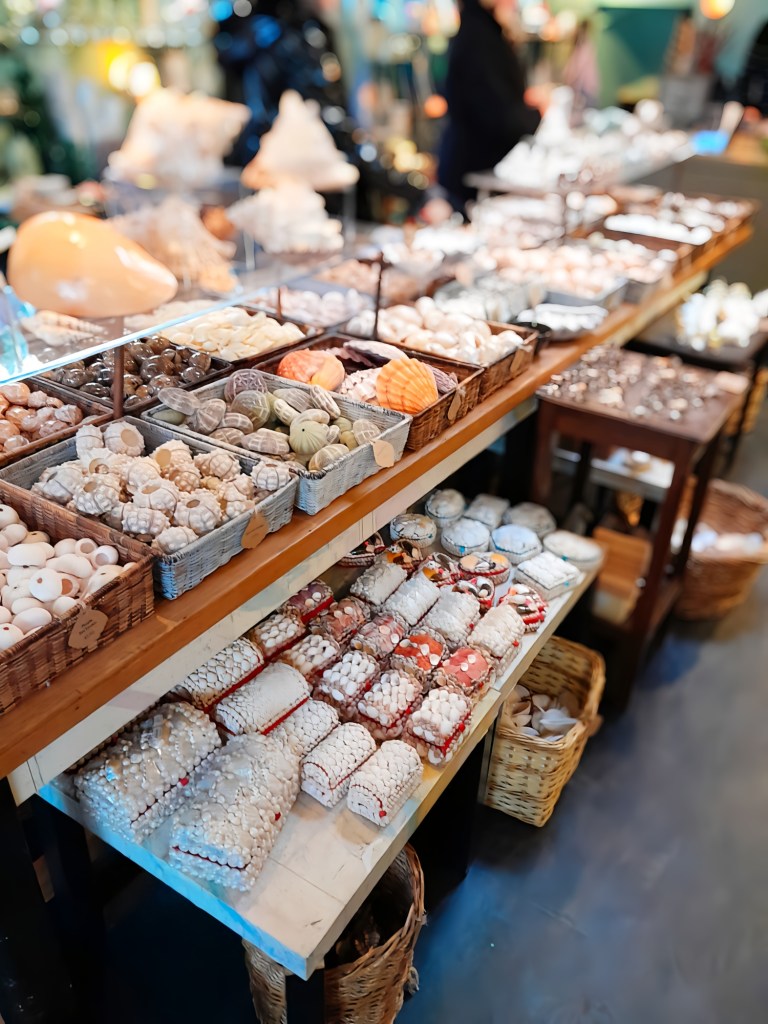
Jaden, unable to contain his curiosity, reached out to gently touch the smooth curves and intricate patterns of a particular beautiful specimen.
His fascination was clear, his young mind already weaving tales of the creatures that once inhabited these beautiful shells. This vibrant display, a microcosm of the grotto itself, seemed to amplify the mystery and wonder of the place we were about to explore.
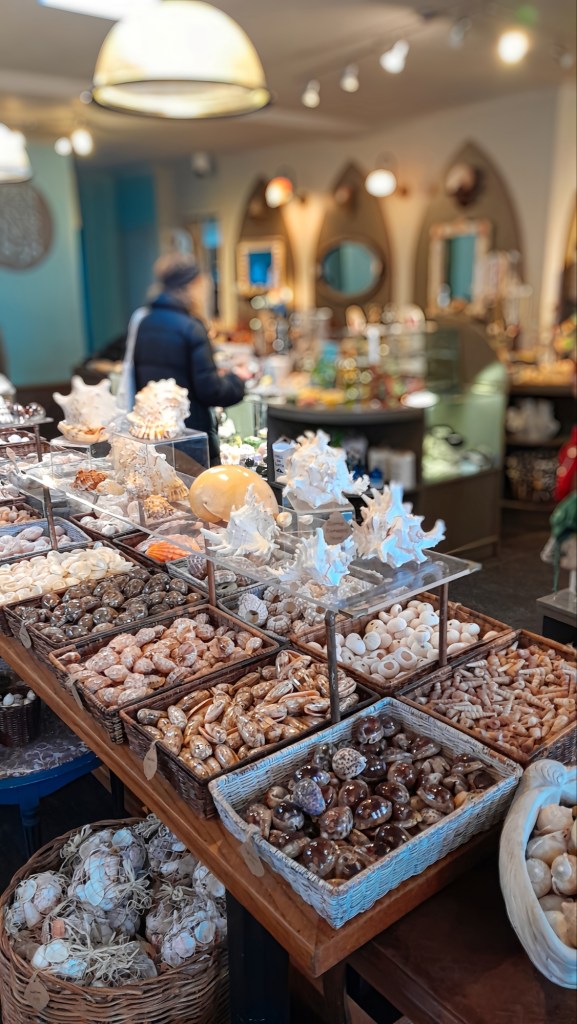
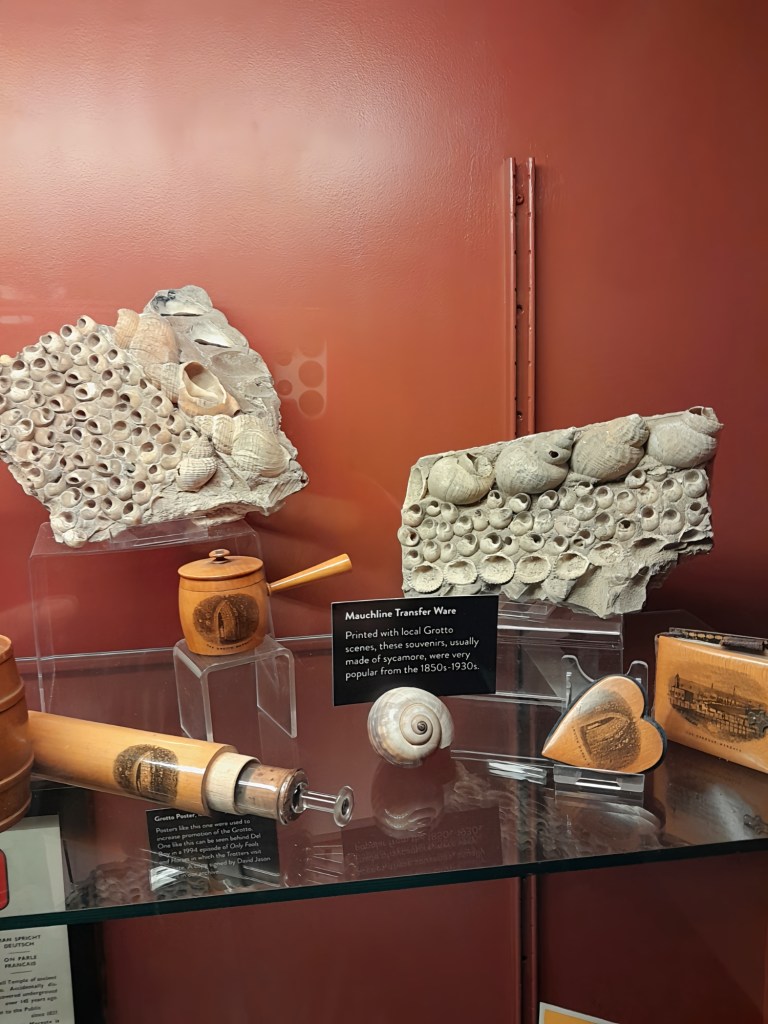
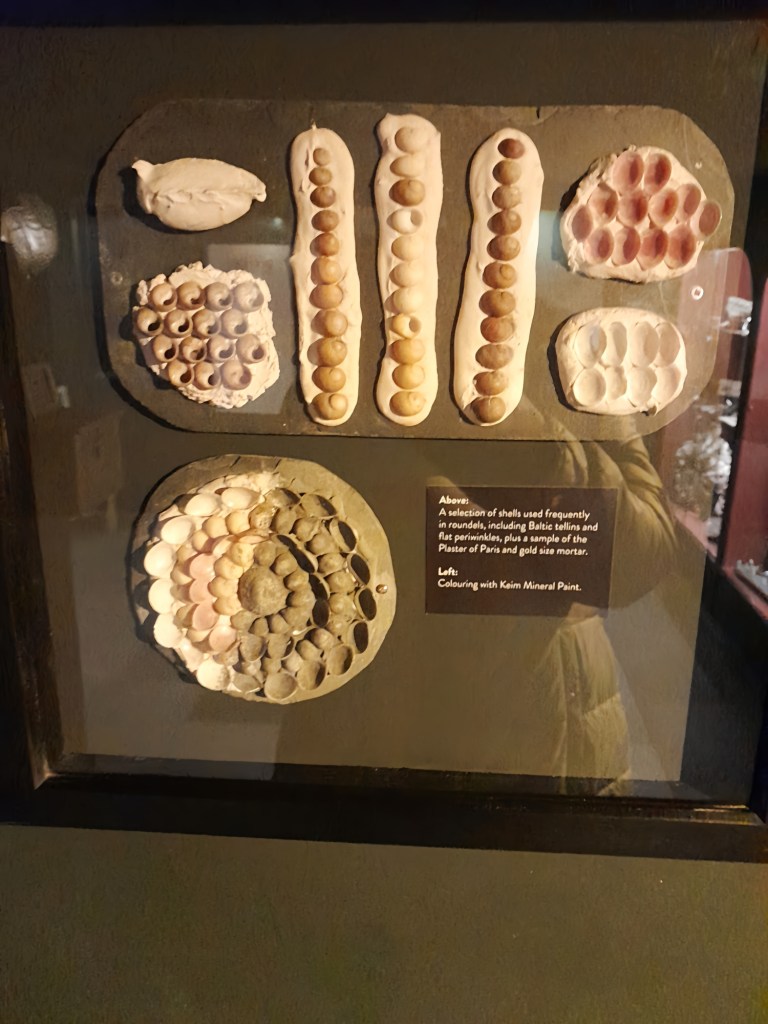
Encased in glass frame, a collection of shells and mortar samples revealed the building blocks of the grotto’s intricate designs. Rows of carefully arranged shells, alongside samples of the plaster and mortar used to bind them, illustrated the painstaking effort involved in creating these mesmerising patterns. It was a fascinating insight into the craftsmanship and dedication of the grotto’s creators.
And then, at the back of the shop, almost hidden in the shadows, we encountered our first true glimpse of the grotto’s magic.
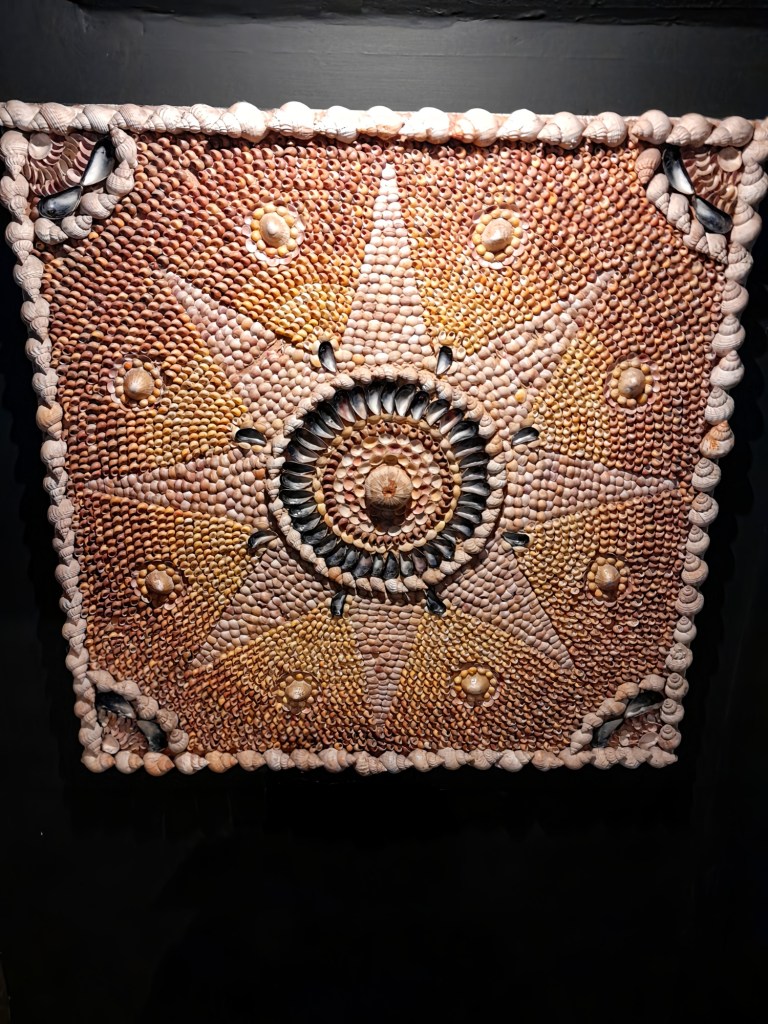
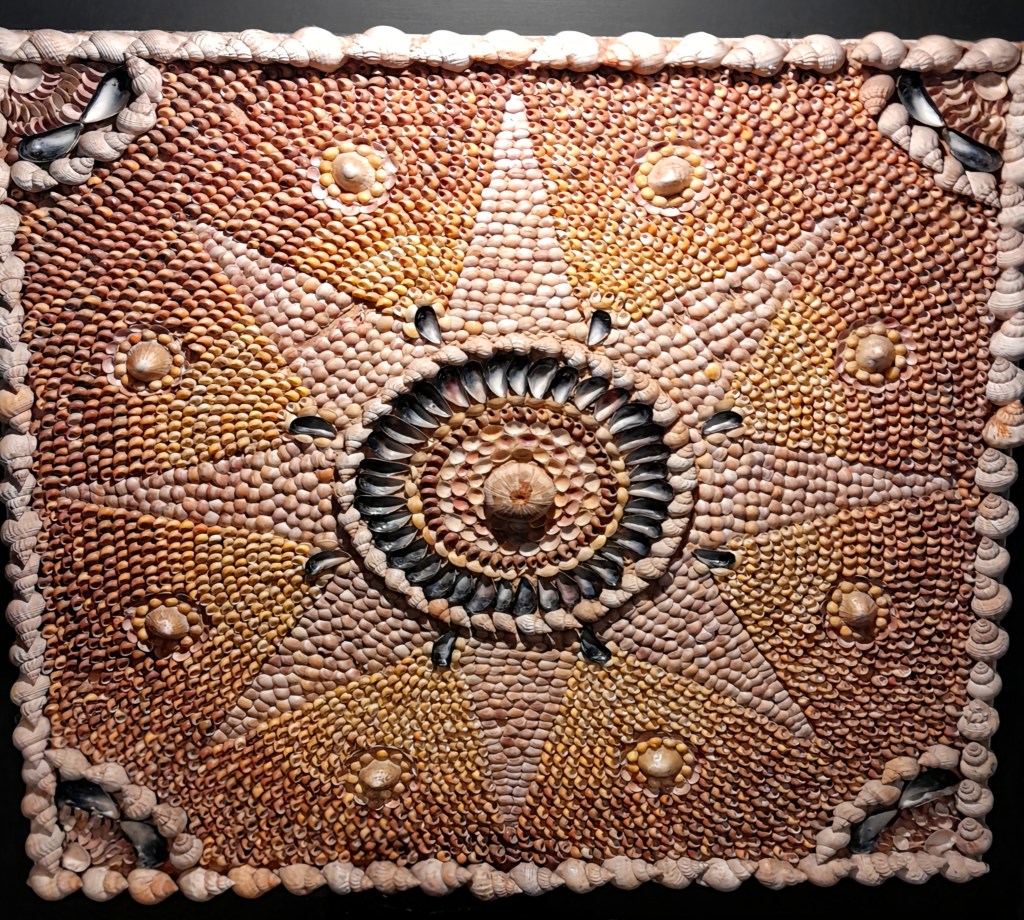
A large shell mosaic, depicting a radiant sunburst, adorned the wall. The intricate patterns and the sheer number of shells used in its creation were breathtaking. It was like a window into the grotto itself, a preview of the wonders that awaited us. This piece, with its vibrant colours and meticulous craftsmanship, seemed to radiate a sense of mystery and wonder, drawing us deeper into the enigmatic world of the Shell Grotto.
The museum curator, a kind woman with a passion for the past, shared her knowledge with us. She explained the mystery surrounding the Shell Grotto, how its origins remain unknown despite years of research. Theories abound, ranging from ancient Roman connections to 18th-century follies, but no definitive answers have been found.
”The 1835 discovery of this grotto is shrouded in mystery,” the curator explained. ”Local lore says that two little children stumbled upon them while playing in a field where a schoolhouse once stood. But there’s no official record of who built it, when or why.”
Jaden, his earlier sombreness forgotten, was captivated by the fascinating mosaics and the sheer number of shells adorning the grotto walls. He peppered the curator with questions, his curiosity reignited by the enigma of this underground wonder.
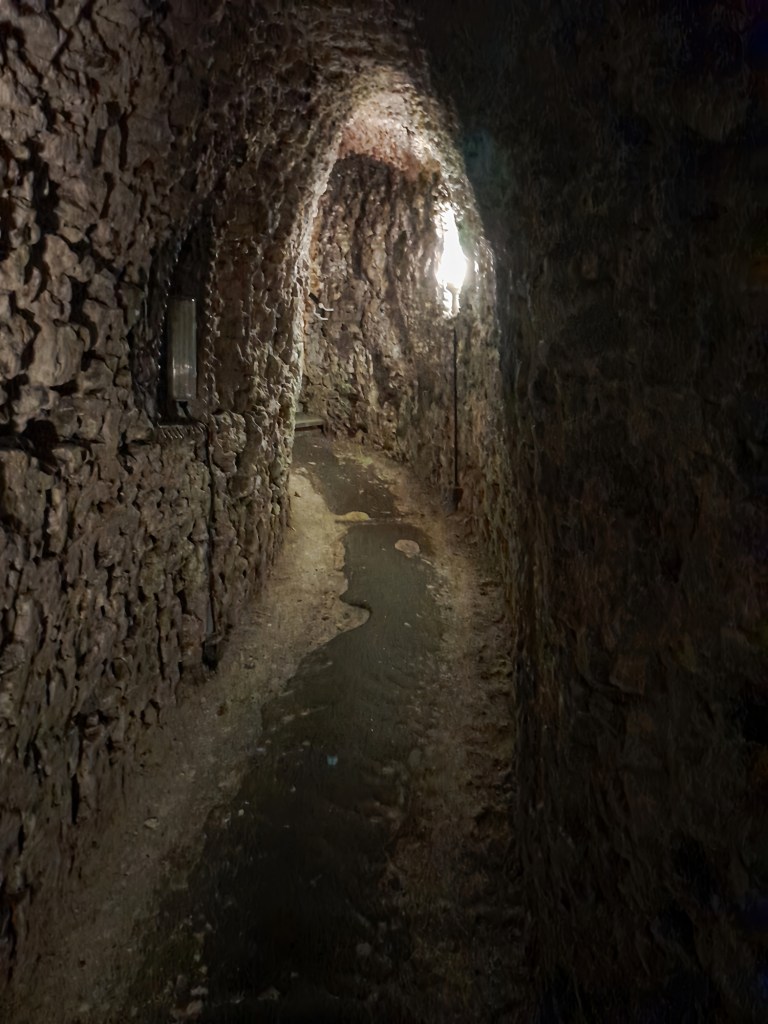
Descending a narrow staircase, we entered the North Passage, a dimly lit tunnel that beckoned us deeper into the earth.
The cool, damp air was thick with the weight of history, and the silence was broken only by the echoes of our footsteps. Millions of shells meticulously arranged in swirling patterns, glimmered in the dim light, creating a mesmerizing spectacle. We felt a sense of awe and wonder, as if we had stepped into another world. The North Passage, with its rough-hewn walls and low ceiling, wound its way through the earth like a secret tunnel.
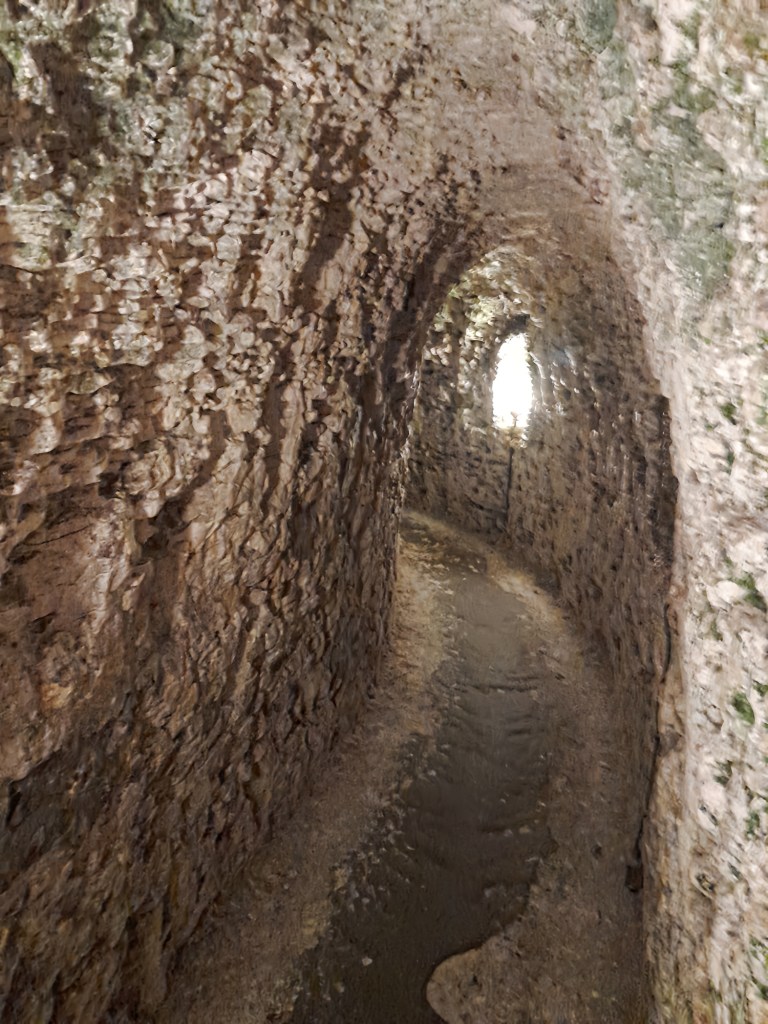
The path was narrow and uneven, but the anticipation of what lay ahead kept us moving forward. The shells, embedded in the walls like sparkling jewels, shimmered in the dim light,guiding us towards the heart of the grotto. And then, at the end of the passage, a magnificent sight unfolded before us.
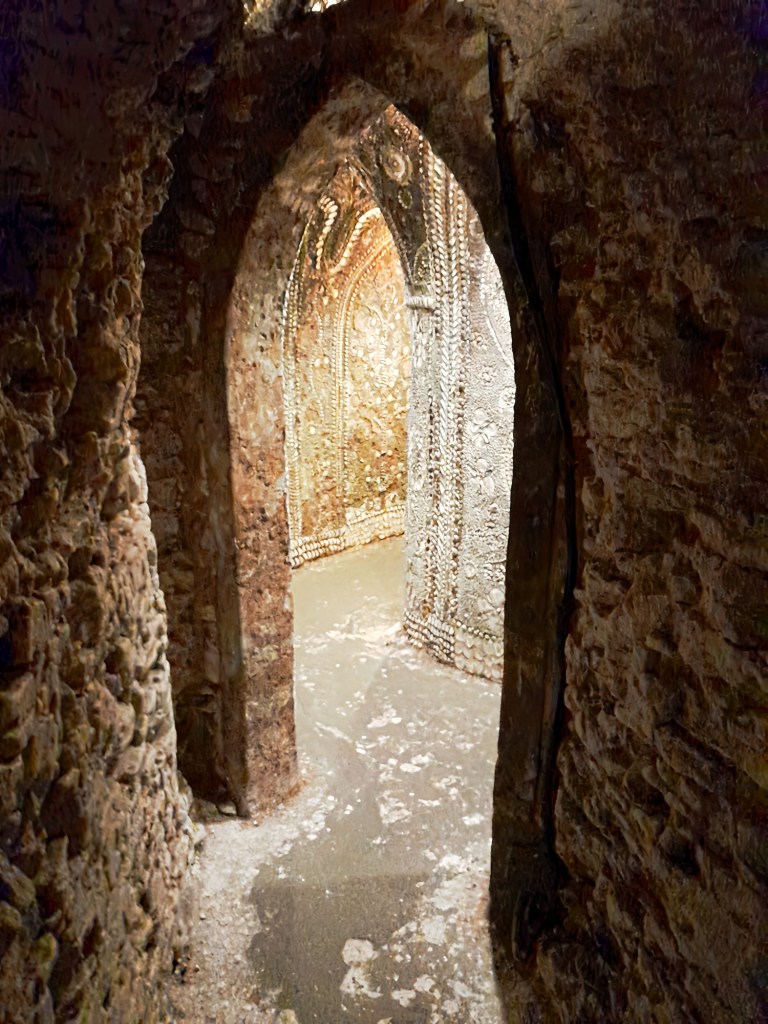
A grand arched doorway, intricately decorated with shells, marked the entrance to the Rotunda, the central chamber of the grotto. The sheer beauty and craftsmanship of the doorway took our breath away. It was like a portal to another world, a testament to the artistry and dedication of the grotto’s creators. We stepped through the doorway, eager to explore the wonders that awaited us within the Rotunda. Somewhere between Indiana Jones and Lara Croft, there was me, just trying to find my way in this adventurous world.
And there, amidst the swirling patterns of shells, we discovered the intricate design of the Persea Tree.
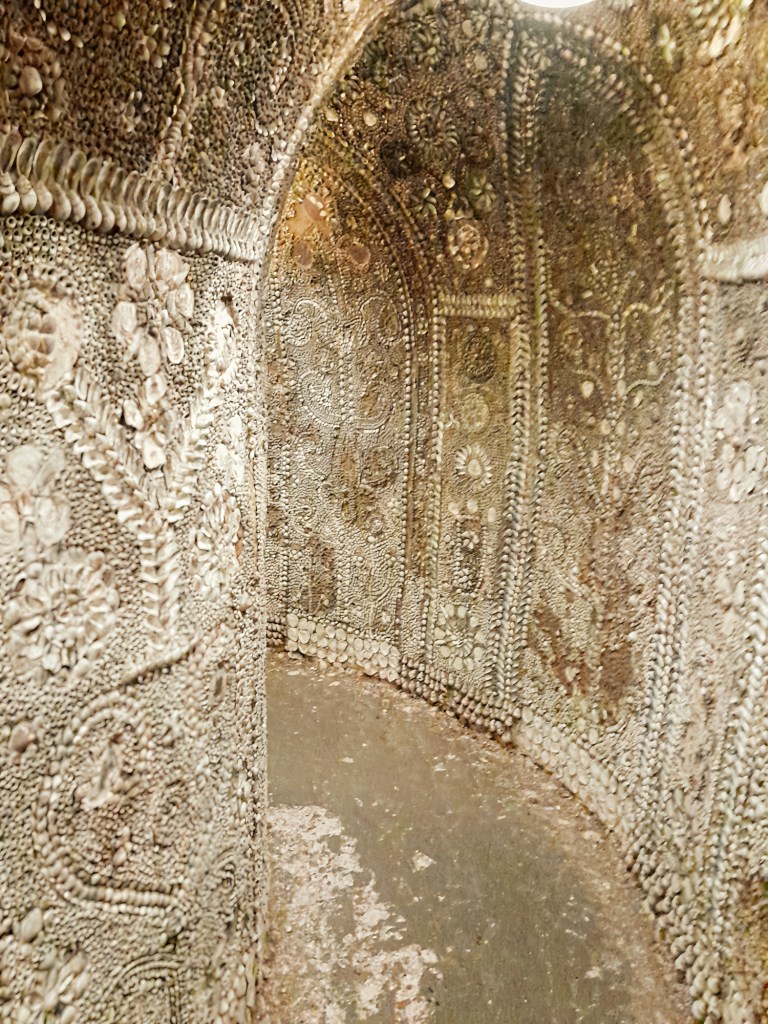
The delicate branches, laden with shell-fashioned leaves and fruit, seemed to reach out from the walls, creating a sense of enchantment and wonder. I traced the patterns with my fingers. marvelling at the intricate details and the sheer artistry of the design. But the wonders of the Rotunda didn’t end there. Even the corridors leading to this central chamber were adorned with breathtaking shell mosaics.
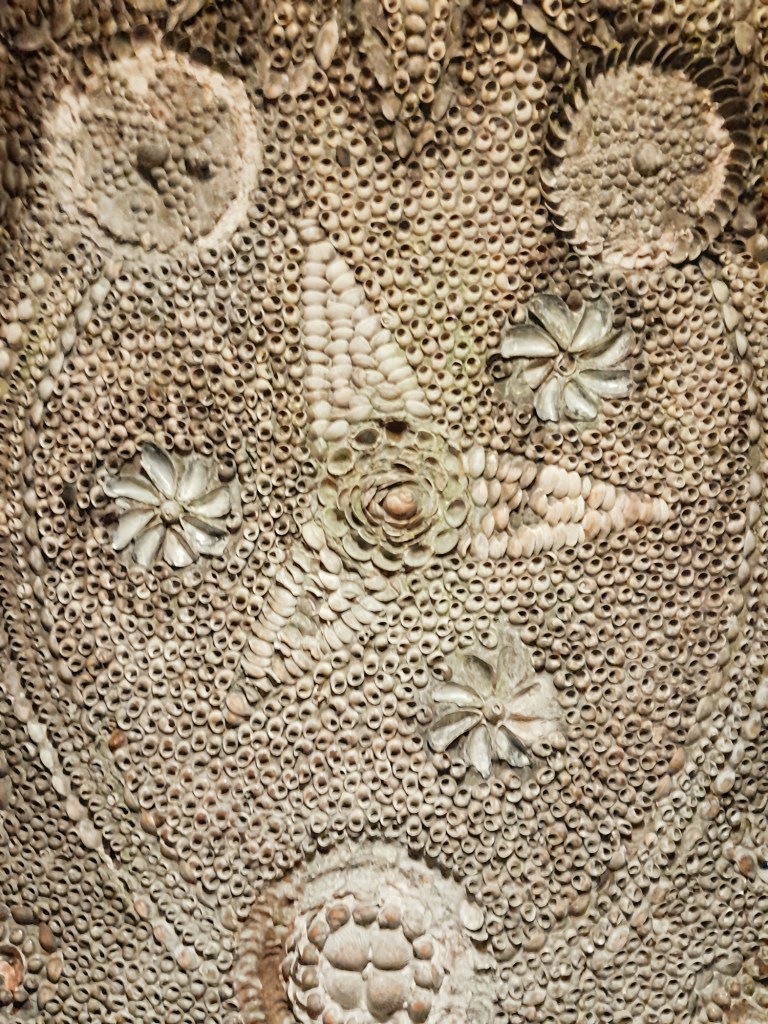
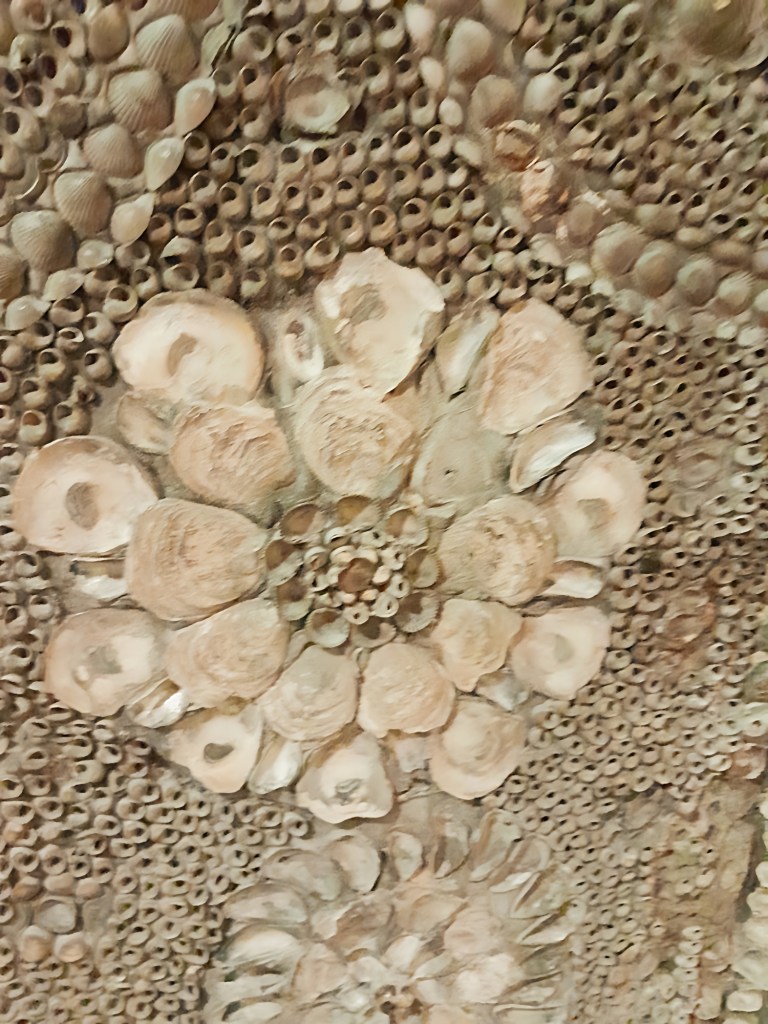
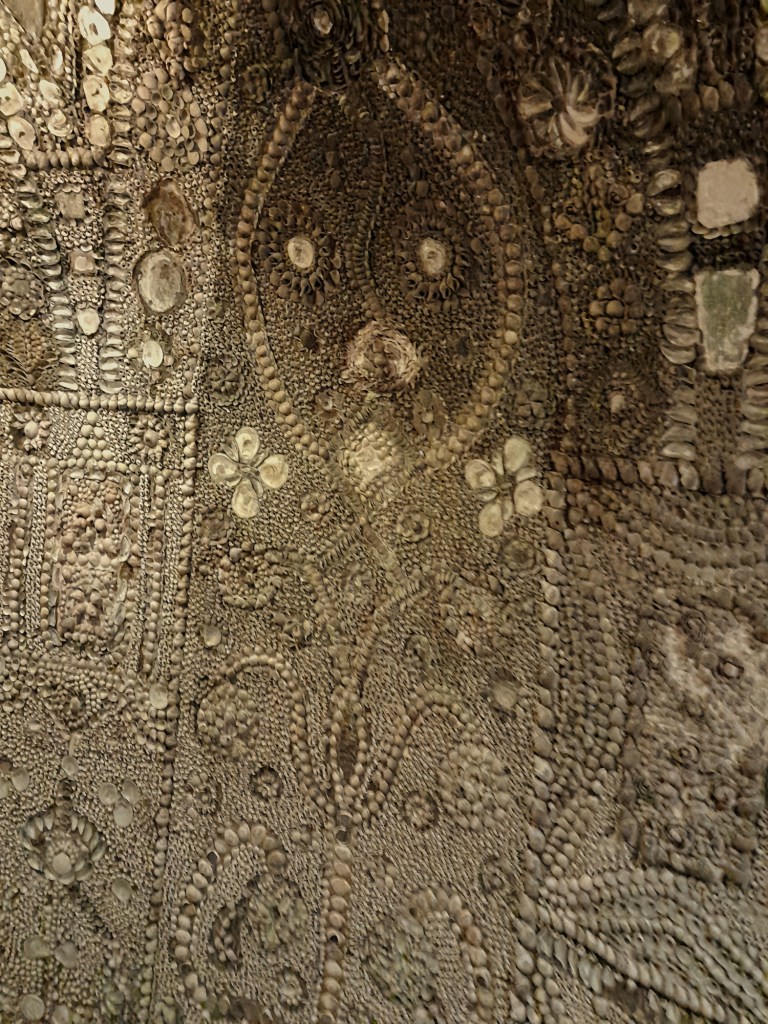
These mosaics, exquisite masterpieces of shellwork, showcase the incredible artistry found within the grotto. Delicate floral patterns and bewitching designs, crafted with meticulous care, transform the subterranean walls into a hidden gallery of shell-covered wonders.
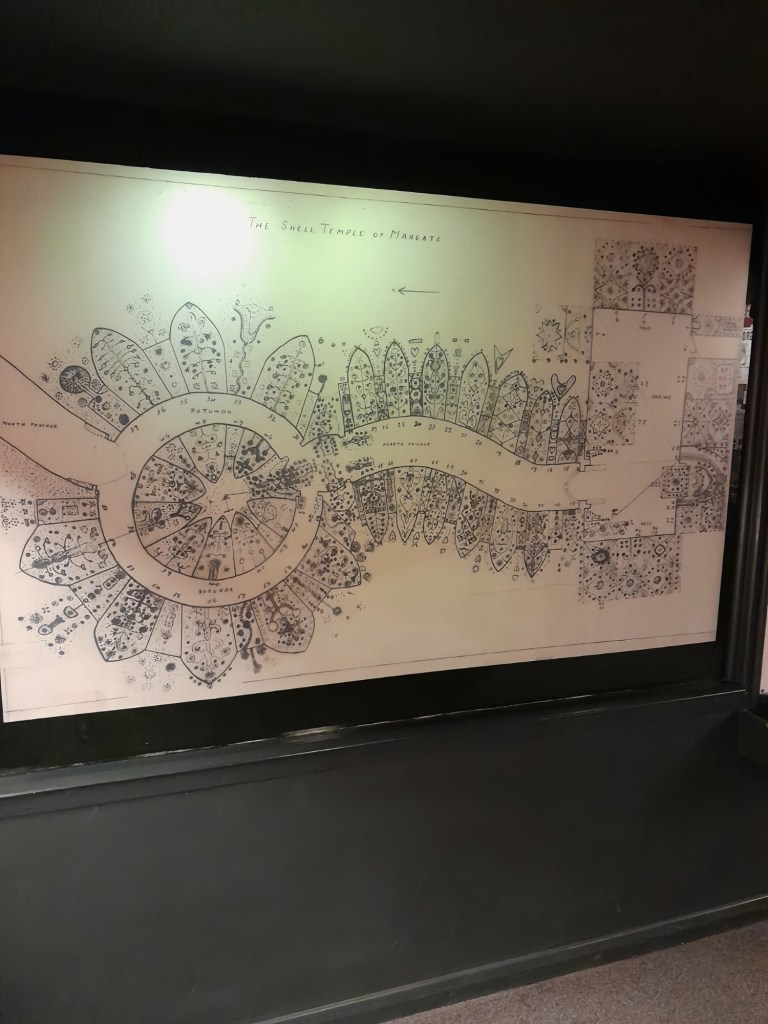
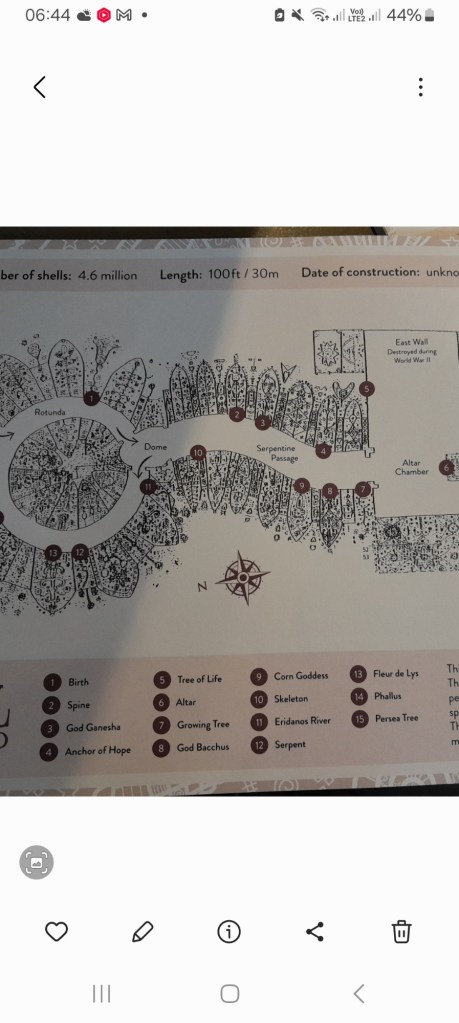
We consulted our handy map and discovered that a recurring symbol around the Rotunda represented ”Birth.”
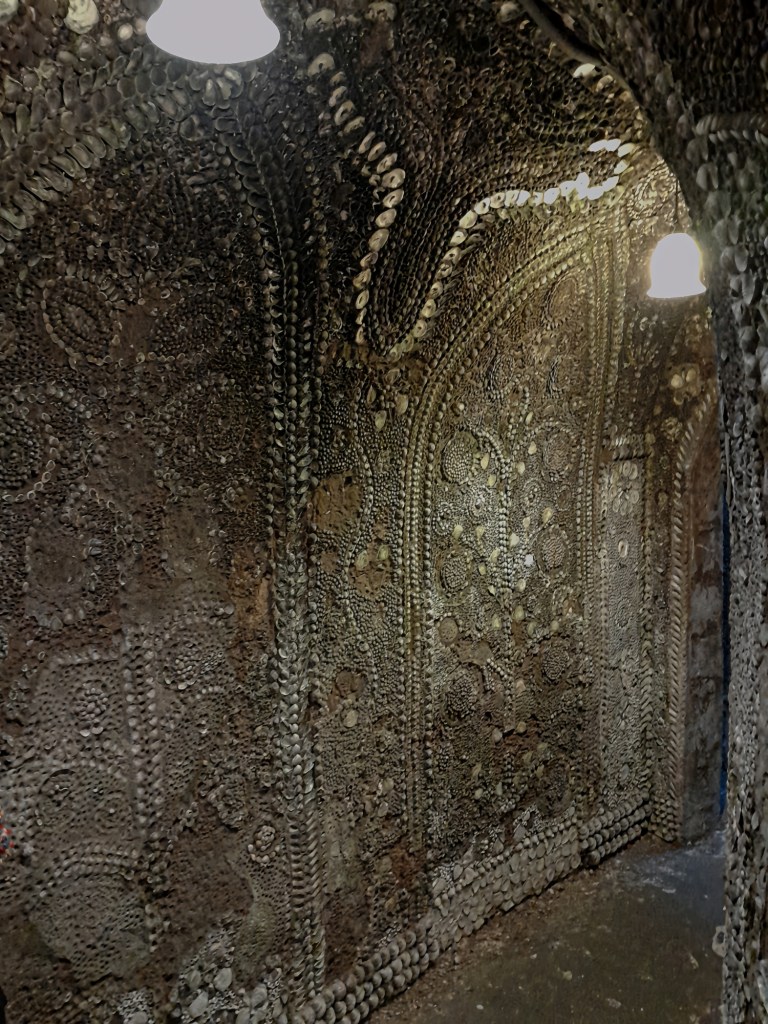
This symbol, with its intricate patterns and symbolic meaning, added another layer of depth and intrigue to the grotto’s mysteries. Why would the creators incorporate such a symbol? Does it represent a symbolic rebirth or a literal birth? Could the grotto have been a sacred space for a secret society, with the symbol marking a ritualistic initiation like some researchers stated? Or perhaps it was a personal shrine, commemorating a significant life event for the creator? The possibilities are tantalizing, leaving us to ponder its true purpose.
As we journeyed through the passage, our eyes were drawn to the mysterious and complex mosaics that adorned every surface. It felt like stepping into the pages of an ancient myth. Each mosaic, each twist and turn of the passage, added another layer to the enigmatic tale unfolding before us. Every step was a journey further into the unknown, a descent into a world where imagination reigned and the boundaries between reality and fantasy blurred.
On the other side of the Rotunda, a different set of symbols captured our attention. The Phallus, the Fleur-de-lys and the Serpent.
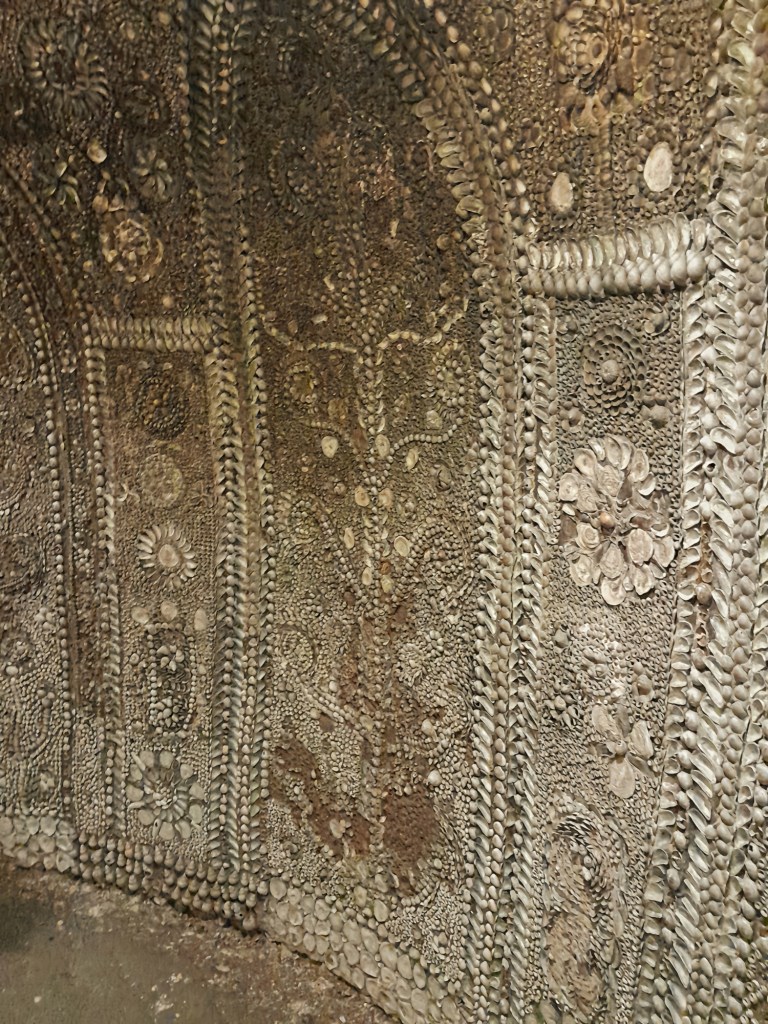
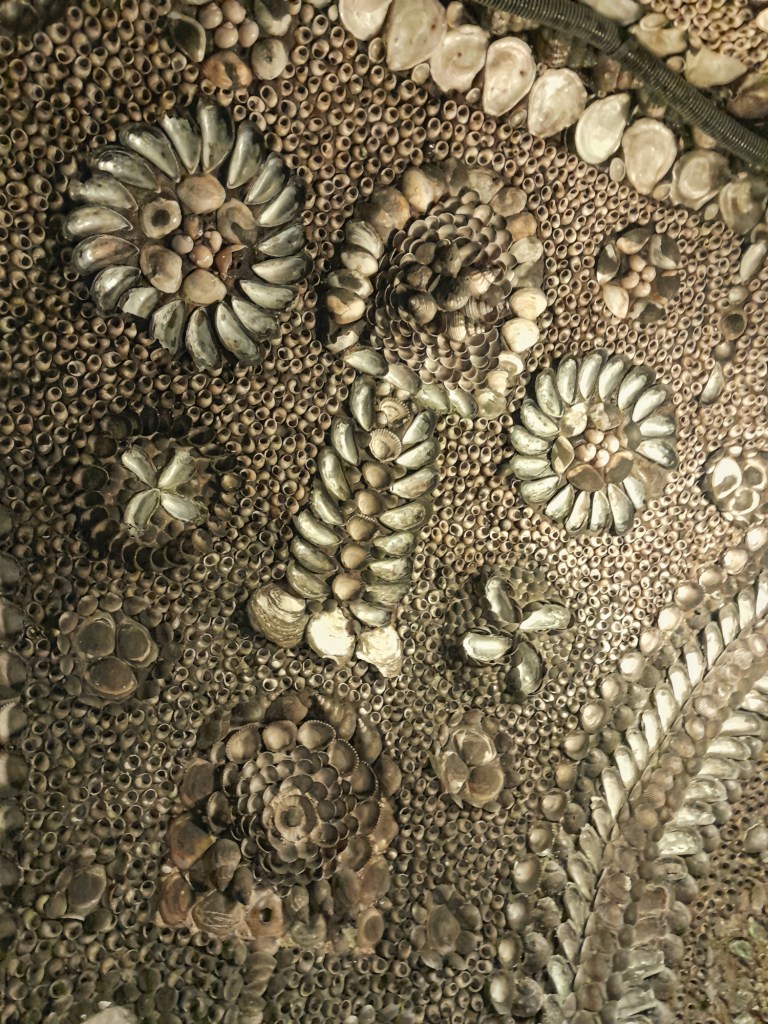
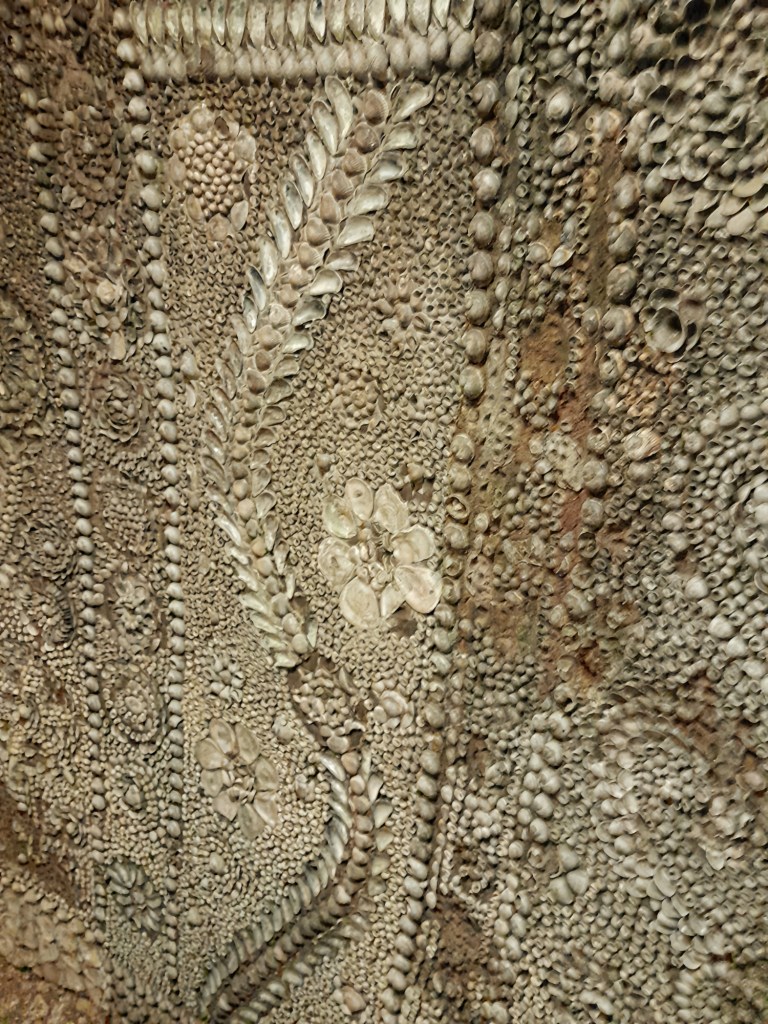
I was fascinated by the juxtaposition of these symbols, their meanings intertwined in a tapestry of mystery and symbolism. What secrets did they hold? What stories did they tell? The phallus represents fertility, potency, and male generative power. It’s found in various cultures throughout history, often appearing in art, religion, and mythology. The Fleur-de-Lys, on the other hand, is often associated with French royalty. It represents royalty and power, and in some religions, it symbolises purity, chastity, and the Holy Trinity. In paganism, the serpent could likely represent knowledge, fertility, or duality, while also symbolises chaos and destruction in other religions. Its exact presence there remains open to interpretation. It was like a puzzle to be solved, each symbol a piece that hints at a deeper meaning. Do they represent life cycles, the union of opposites, or a place of initiation? Perhaps they’re pieces of a hidden code waiting to be cracked.
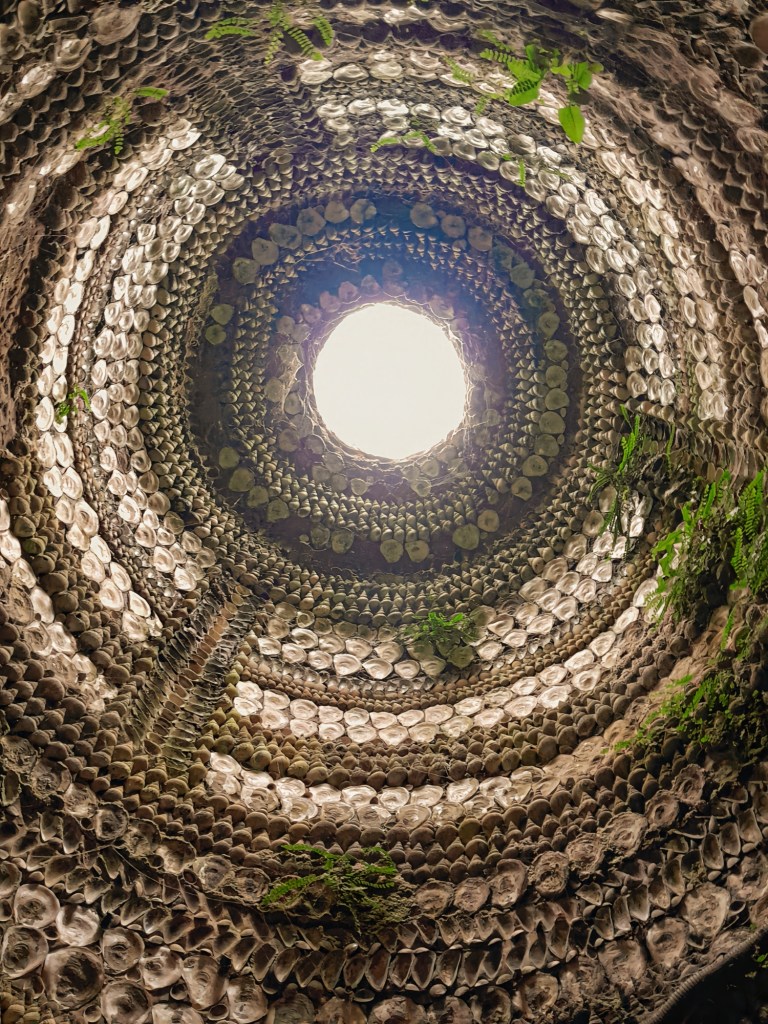
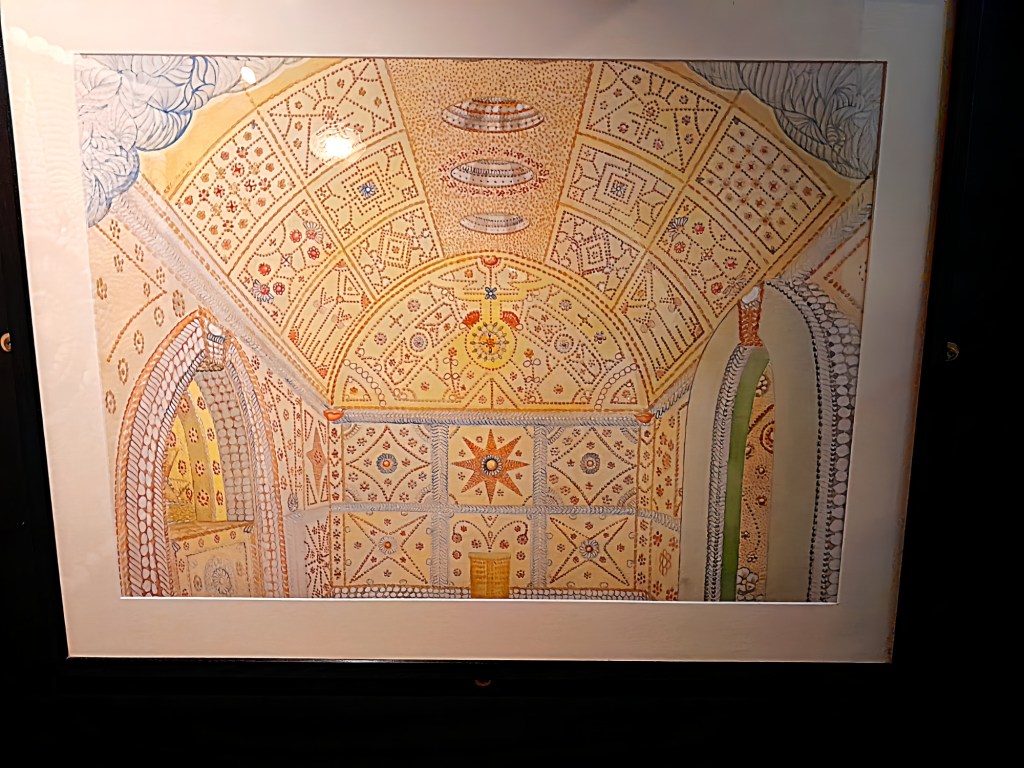
Venturing deeper into the heart of the grotto, we came across a doorway leading to another passage. Intrigued, I urged Jaden to step through and found ourselves in the Dome, a circular chamber with a breath-taking ceiling. The Dome was a masterpiece of shell mosaic art.
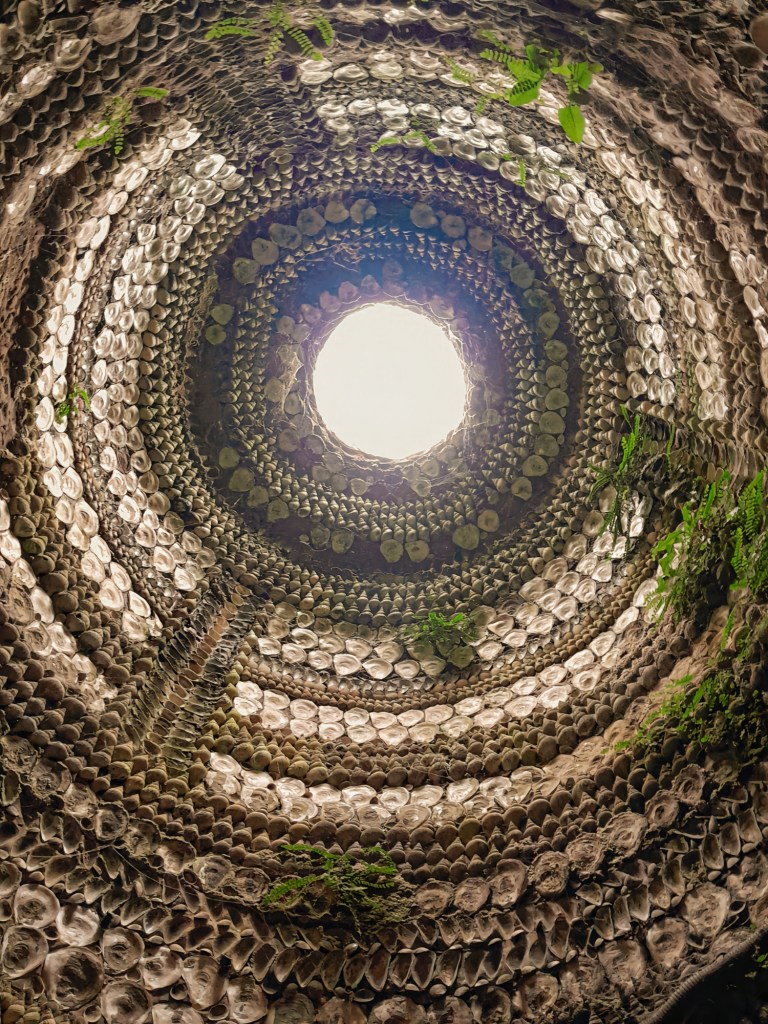
Countless shells, arranged in a mesmerizing spiral pattern, adorned the ceiling, drawing our eyes upwards towards a single source of light. The effect was breath-taking, as if we were gazing up at a starry night sky. The light filtering through the top of the Dome illuminated the centre of the grotto, casting an ethereal turquoise glow upon the shells adorning the walls casting intricate shadows and highlighting the textures of the shell. It was quite a sight, as if the grotto itself was coming alive with light and colour. It was a truly magical experience, like stepping into a fairy-tale realm.
While it undoubtedly served a practical purpose – channelling light into the subterranean space – its symbolic significance is equally intriguing. What deeper meaning might this dome hold? Is it a metaphor for the heavens, a celestial portal connecting the earthly realm to the divine? Watching Jaden gaze up at the dome in wide-eyed wonder, I couldn’t help but be reminded of Joshua, the young boy who stumbled upon this hidden world two centuries ago. The same spark of curiosity, the same thirst for adventure, shining in their eyes. Jaden, with his boundless energy and inquisitive spirit, seemed to embody the very essence of exploration, a modern-day Joshua ready to uncover the secrets of the Shell Grotto.
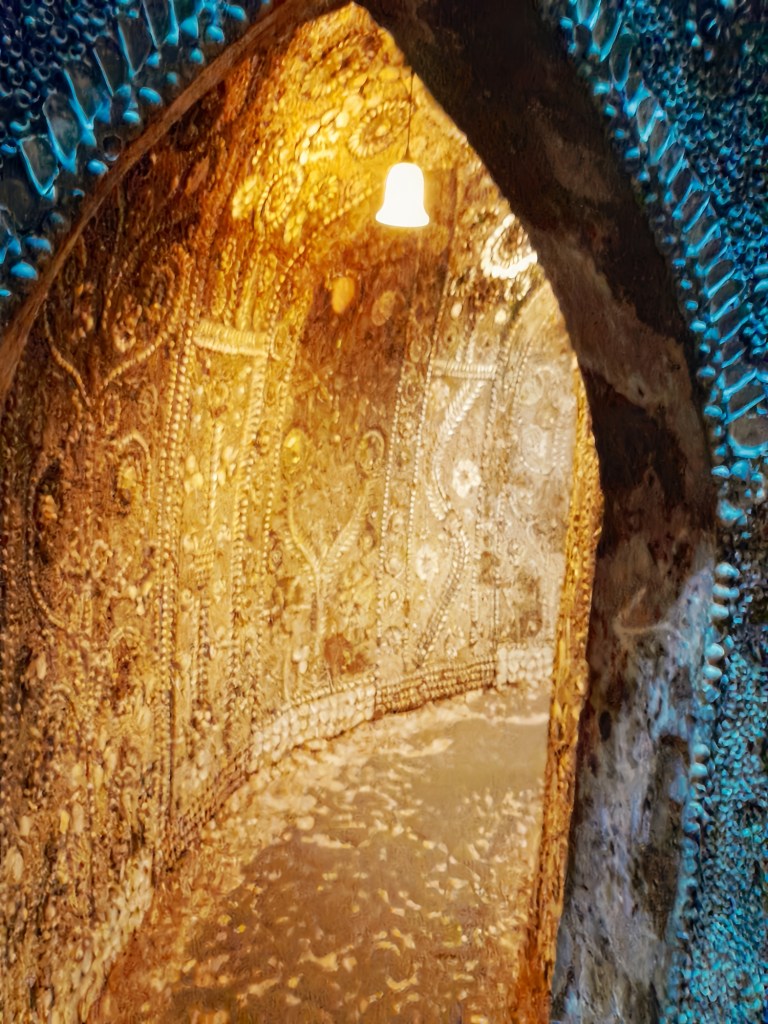
As we explored further, we discovered that the mesmerizing turquoise glow extended beyond the Dome’s chamber, illuminating the surrounding passages with an overworldly light. Leaving the ethereal glow of the Dome behind, we kept going deeper into the labyrinthine depths of the Shell Grotto, following the twists and turns of the Serpentine Passage. This narrow corridor, with its undulating walls and shell-crusted surfaces, seemed to writhe and snake its way through the earth, beckoning us further into its mysterious embrace.
And then, amidst those swirling pattern of shells, we stumbled upon a striking image: a skeleton design. Jaden’s eyes widened as he took in the skeletal design, a hushed ”That’s spooky” escaping his lips in a mix of fascination and fear.
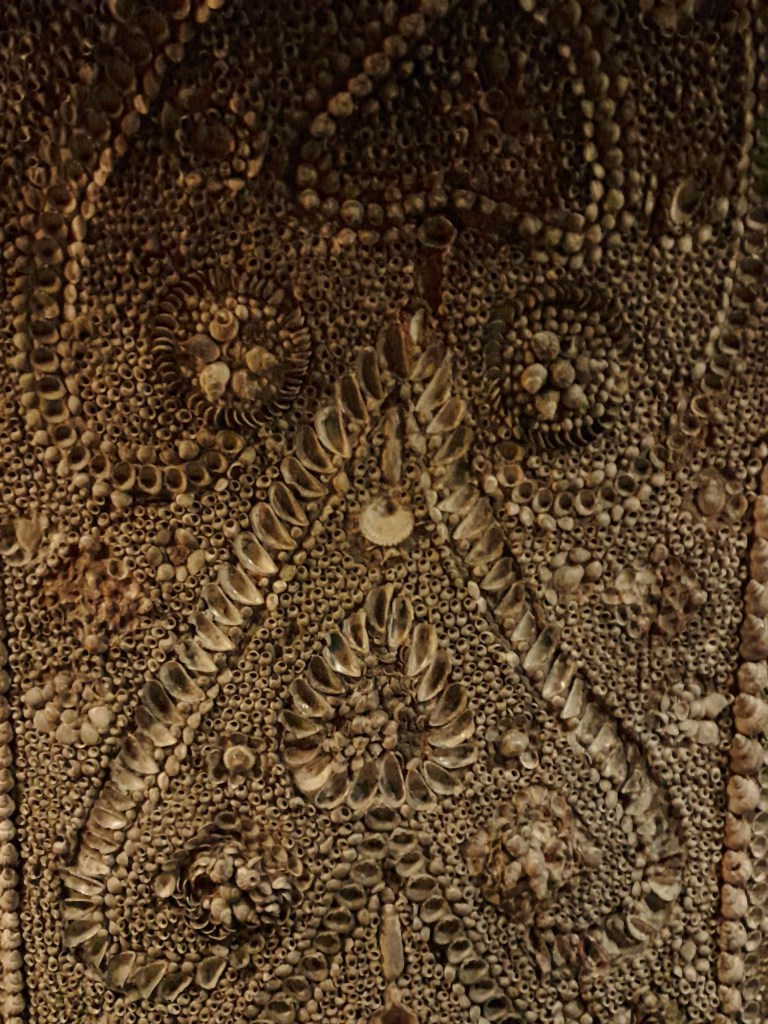
The skeletal figure, meticulously crafted from shells, seemed to emerge from the wall, its bony fingers reaching out from the darkness. It was a stark reminder of mortality, a symbol of the ephemeral nature of life. We studied it in silence, contemplating the meaning of this haunting image, its presence adding another layer of mystery to the grotto’s enigmatic atmosphere. Perhaps it represents transformation and rebirth, echoing the serpent’s symbolic design. Or could it be a guardian of the underworld, protecting the secrets hidden within the grotto’s depths? Its presence lingers in the mind and prompts a myriad of questions.
Continuing along the Serpentine Passage, we encountered a series of captivating mosaics on the right-hand side, each depicting a different figure or symbol. We came across the Corn goddess, her shell-encrusted form representing abundance and fertility. Next, we encountered god Bacchus, the Roman deity of wine and revelry, his presence hinting at a connection to celebration and earthly pleasures. Finally, along the way, we beheld the Growing Tree, its branches reaching upwards, symbolizing growth, renewal, and the interconnectedness of life.
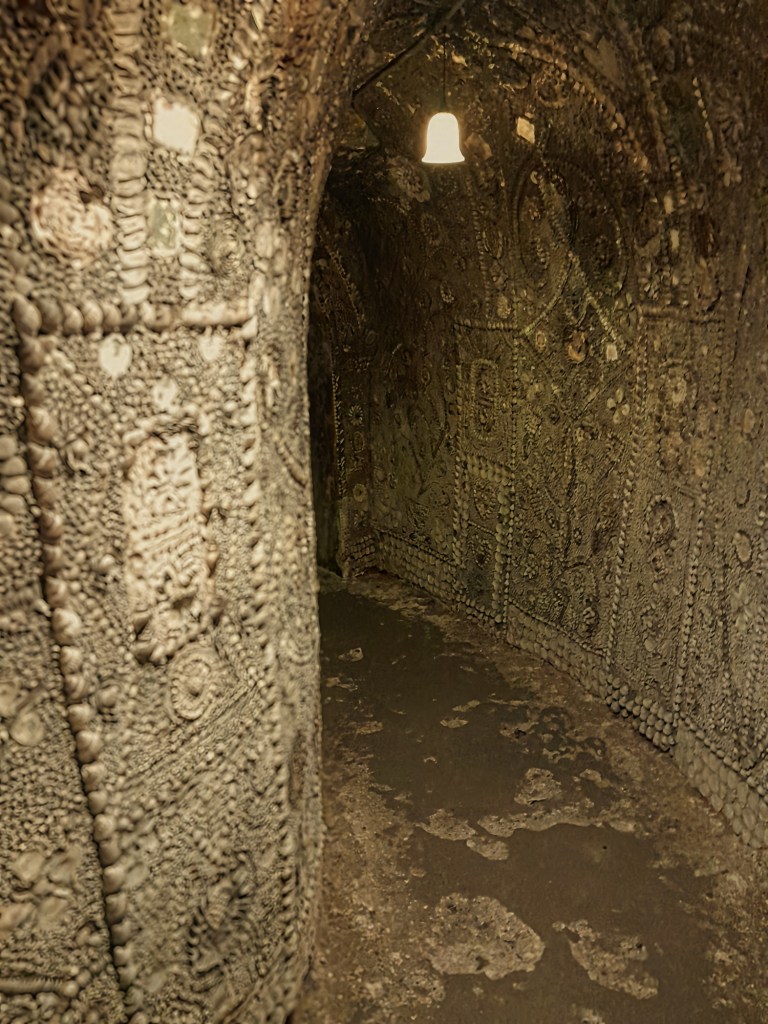
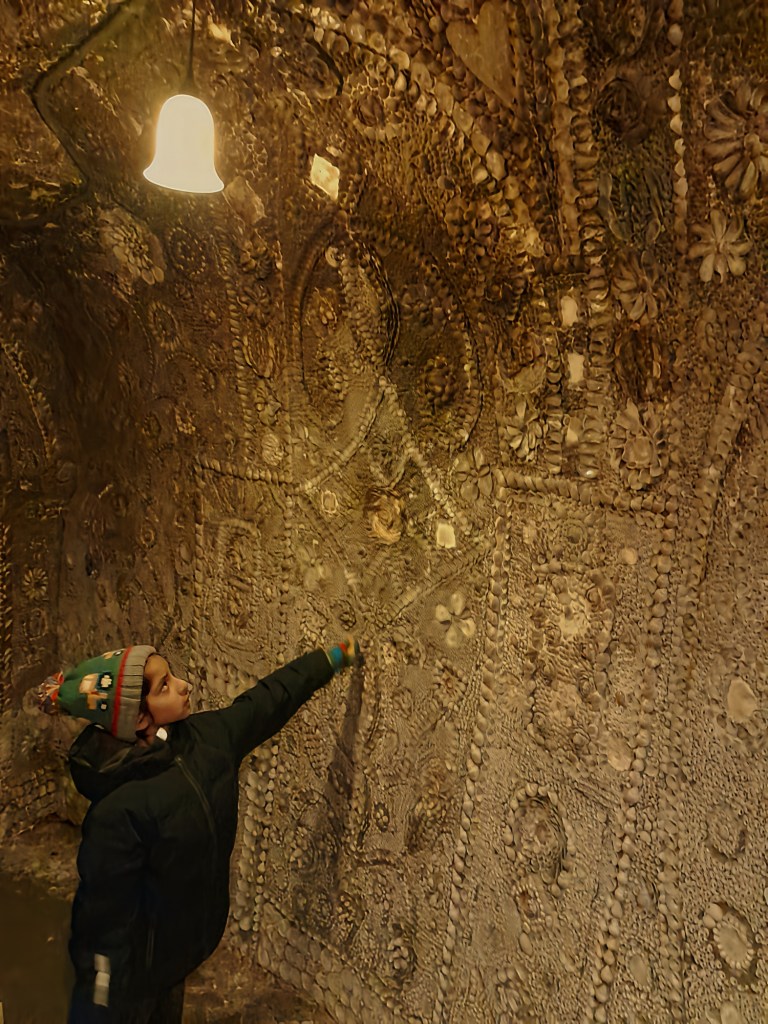
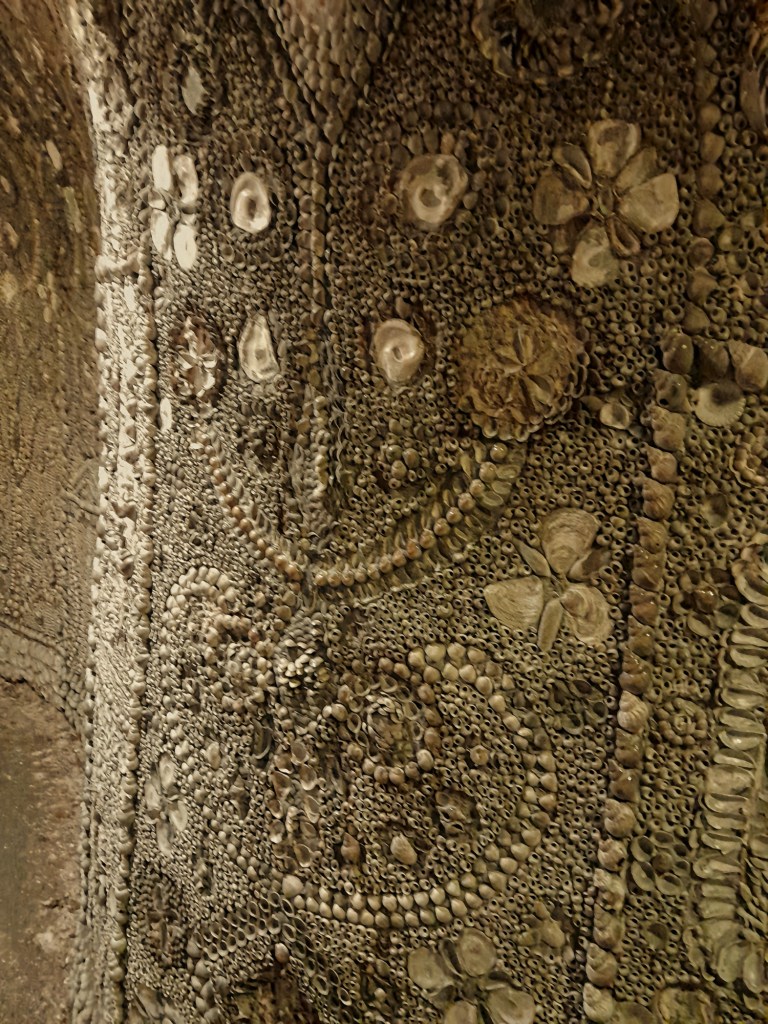
This was a trinity of symbols hinting at fertility rituals, celebrations of nature, or perhaps even deeper mystical practices. Were the grotto’s creators invoking these deities for abundance, or is there a more profound meaning woven into this shell-made canvas? Each step deeper left me with more questions than answers, lost in a labyrinth of symbols and speculation.
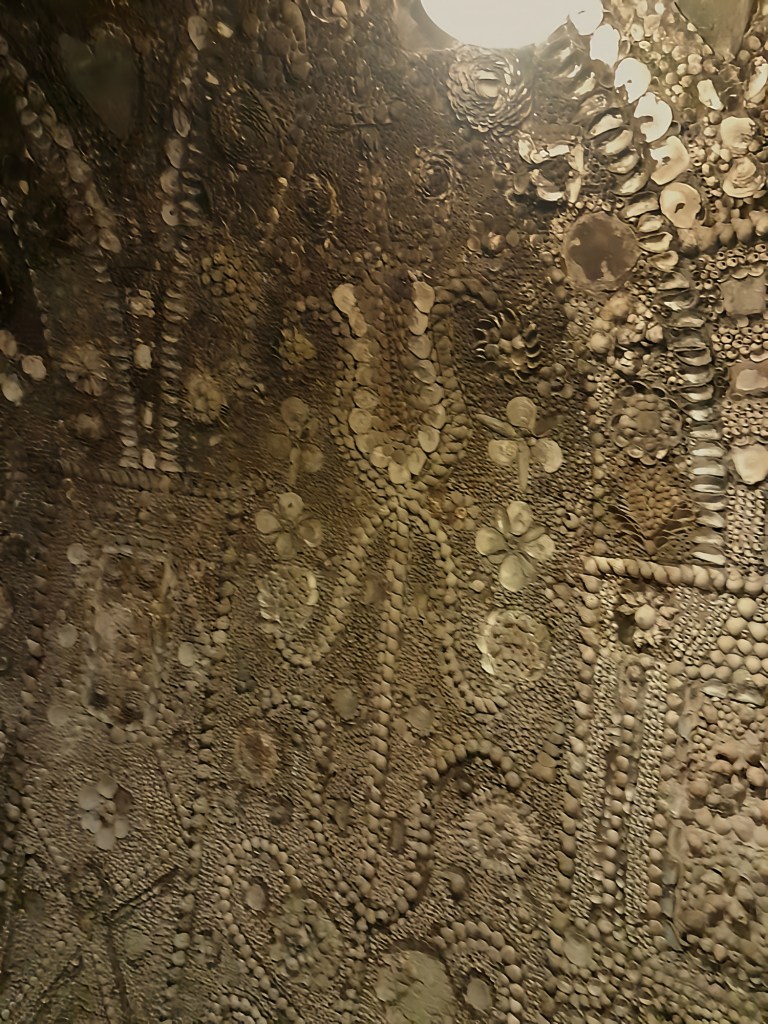
On the left-hand side of the passage, a different set of symbols emerged from the shell-covered walls. A detailed depiction of the human spine, with its intricate network of vertebrae, seemed to speak to the complexities of the human body.
Its presence within the grotto was intriguing and unsettling. Why would the creators incorporate such a stark anatomical image into this underground wonderland? Could it represent the backbone of life itself, the essential structure that supports our physical existence and the flow of energy? Or was it a visual metaphor for the hidden metaphor for the hidden pathways that connect all living things? Whatever its intended meaning, the spine design adds another layer of complexity to the grotto’s enigmatic narrative. Next, we encountered the Hindu elephant deity, Ganesha, whom in the Hindu pantheon, is revered as a symbol of abundance, knowledge and the remover of obstacles.
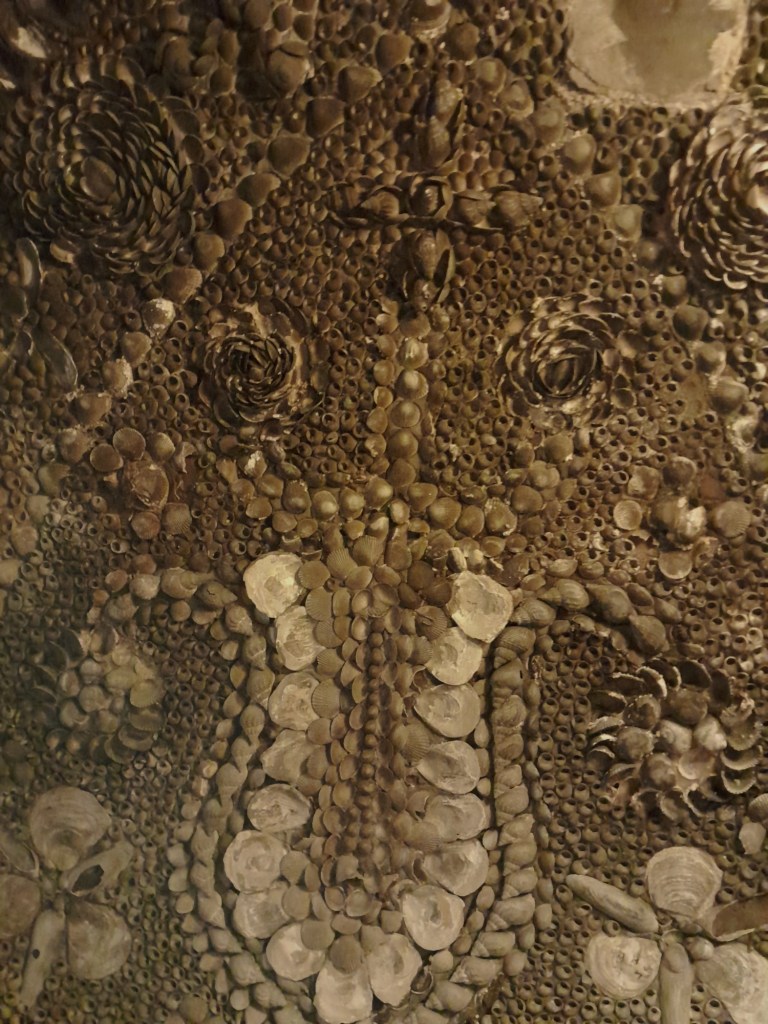
The unexpected presence of this hindu idol in the Shell Grotto raised another set of questions in my mind. Why this lone Hindu deity? What connection did the creators have with him?
The presence of these diverse symbols, drawn from various cultures and belief systems, sparked a sense of curiosity and wonder within me. Why were pagan gods and goddesses from different cultures represented in this hidden grotto? Was it a place of worship for a diverse group of people? Or was it a symbolic representation of world’s religions and spiritual practices? The mystery deepened, and we found ourselves drawn further into the grotto’s enigmatic maze, approaching the Altar Chamber entrance.
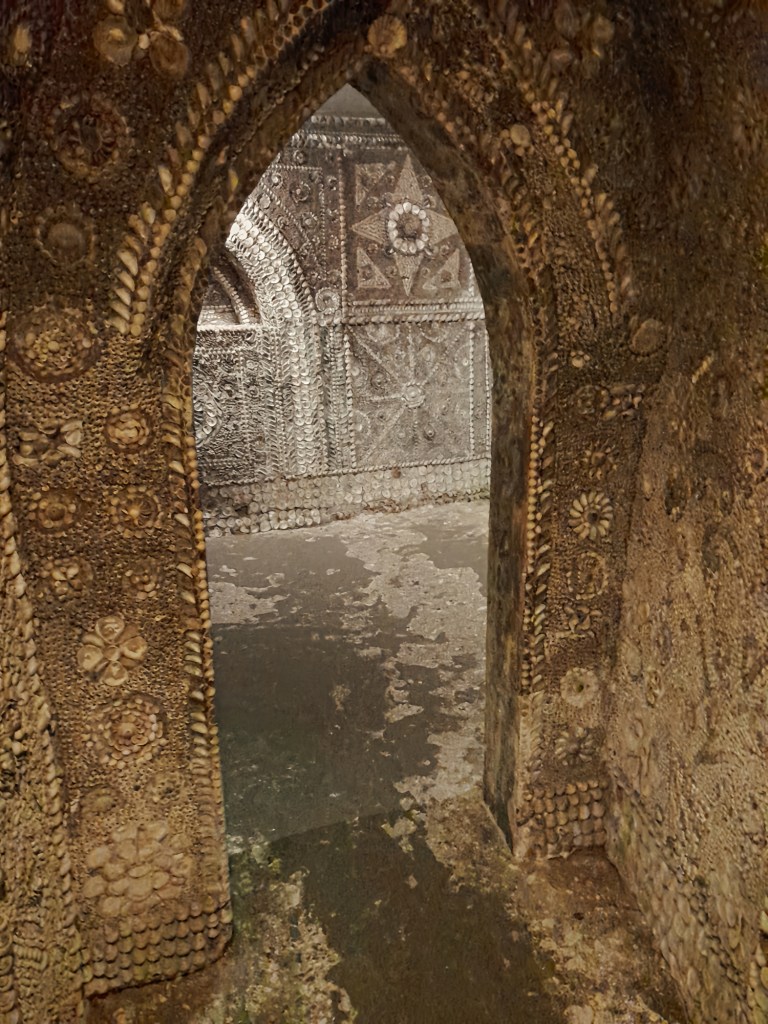
A sense of forbidding washed over me. What would we find inside? I recalled the tales I had read about the sacrifices and rituals that may have been held within these walls, and the mixture of emotions – curiosity, trepidation, and a touch of fear – battled within me. Stepping inside, our eyes were immediately drawn to the wall adjacent to the entrance door, where the infamous altar stood.
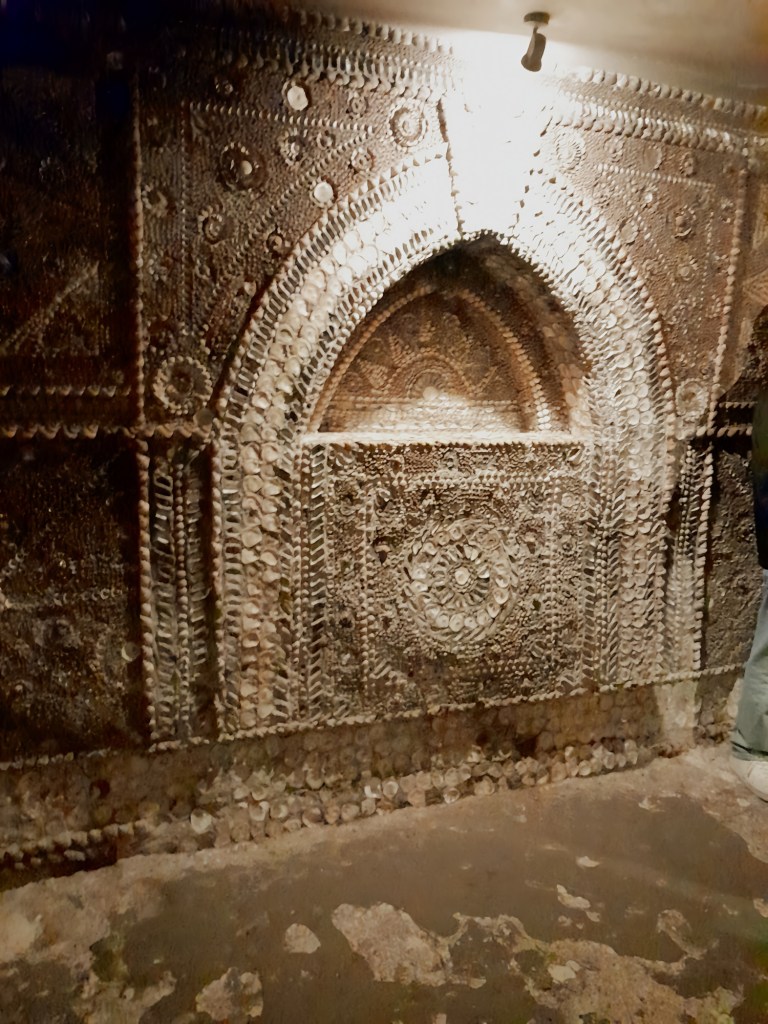
This elaborately decorated alcove, adorned with shells arranged in mesmerizing patterns, dominated the space. Its presence commanded attention, radiating an aura of ancient rituals and forgotten ceremonies. We imagined the secrets it held, the stories it could tell if only it could speak. Was it truly an altar for ancient sacrifices? Or did it serve another, more symbolic purpose?
Just then, a ripple of voices broke the spell. A group of visitors entered, their laughter and chatter echoing off the shell-covered walls. Unlike us, they seemed unfazed by the grotto’s mysteries, treating it as mere amusement. They breezed through the chambers with a cursory glance, their jokes and banter a stark contrast to the quiet awe we had experienced. It was a fleeting reminder that not all who wander are seeking, and that sometimes, the greatest wonders are lost on those who merely glance without truly seeing.
And then, as quickly as they arrived, they were gone. Their voices faded, leaving us once more in the hushed embrace of the grotto. We continued our exploration and it seemed to me as if the shells were shimmering with a brighter luminescence, the mosaics whispering their secrets only to those who truly listened.
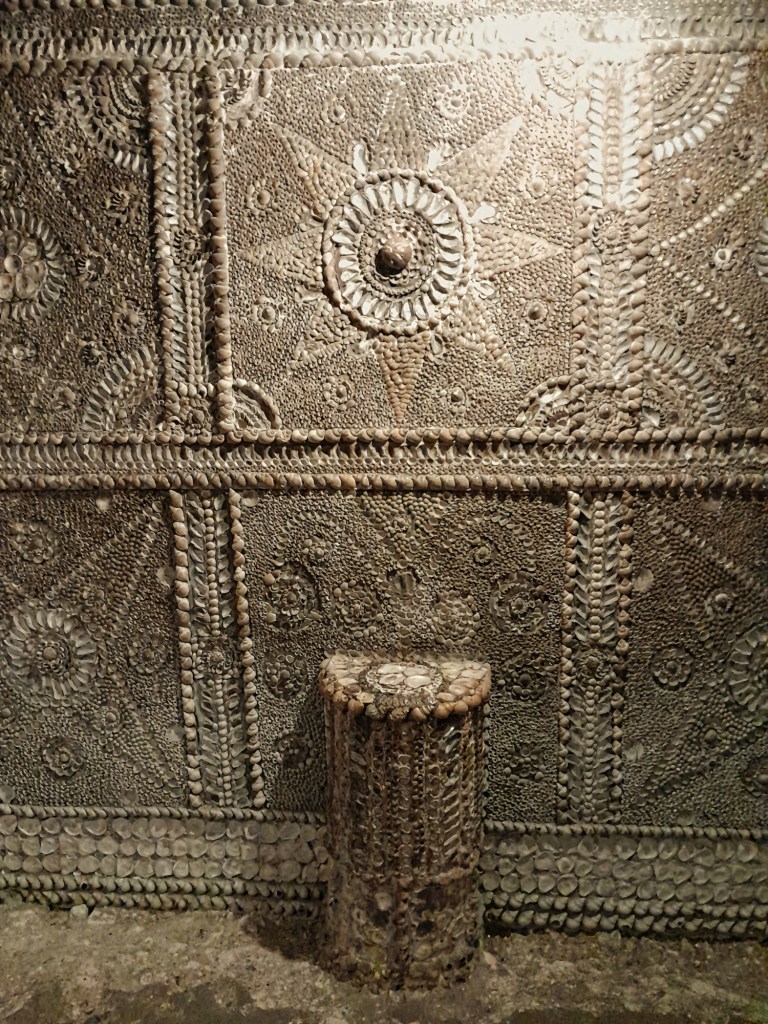
This ‘offering table’ as it’s often called fueled my imagination. Did ancient worshippers once leave offering here to appease their gods? Or did it serve a more mundane purpose? Like holding candles? Could it perhaps be a really fancy shelf for displaying seashells? Or maybe the creators just needed a place to rest their teacups while contemplating the meaning of life amidst all that glittering mosaic. My sense of humour, ever a mischievous companion, was kicking in – a defence mechanism, surely, against the mounting awe and bewilderment of the grotto. The questions lingered in the air like unanswered riddles, echoing the silent chambers of the grotto.
Just above the offering table, a captivating design resembling a solar calendar or sundial held our attention. Was this a tool for tracking the sun’s movement? Or did it hold a deeper symbolic meaning, maybe representing the cyclical nature of life, death and rebirth? This particular symbol evoked the astronomical prowess of the ancient Mayan culture. Like those ingenious sky watchers, the grotto’s creators seem to have possessed a deep fascination with the sun’s movements and cycles. Did they, too, align their creation with celestial events, using the grotto as a subterranean observatory? Or does the sundial serve a more symbolic purpose, representing a connection to the cosmos and the eternal rhythm of time? Perhaps, like the Maya and other cultures who used this process, they believed that understanding the sun’s journey held the key to unlocking deeper truths about the universe and our place within it.
My gaze then shifted to the wall facing the altar, a surface teeming with enigmatic symbols and patterns.
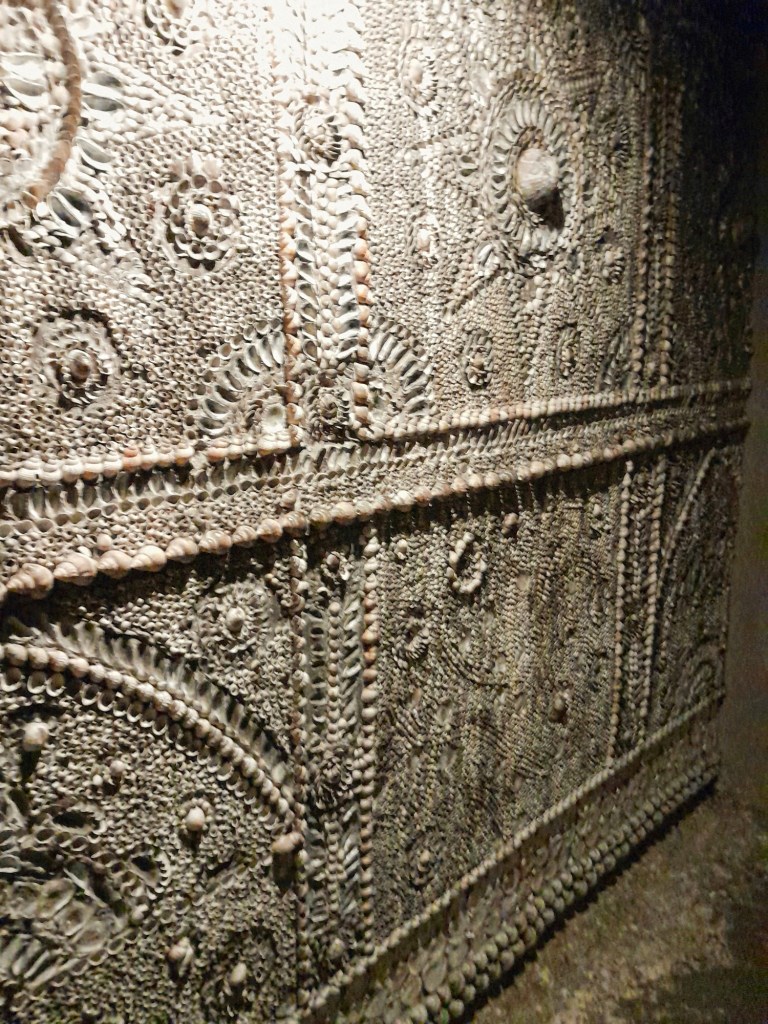
This wall, like a canvas for the grotto’s creators, was filled with a complex yet mesmerizing array of shell mosaics. Circles, spirals and geometric shapes intertwined, creating a visual feast for the eyes. Were they another set of symbols with hidden meanings? Or were they simply artistic expressions, meant to evoke a sense of wonder and awe? The mystery deepened, I found myself lost in contemplation, trying to decipher the secrets held within these enigmatic designs.
Amidst this tapestry of symbols,one design stood out to me in particular: The Tree of Life.
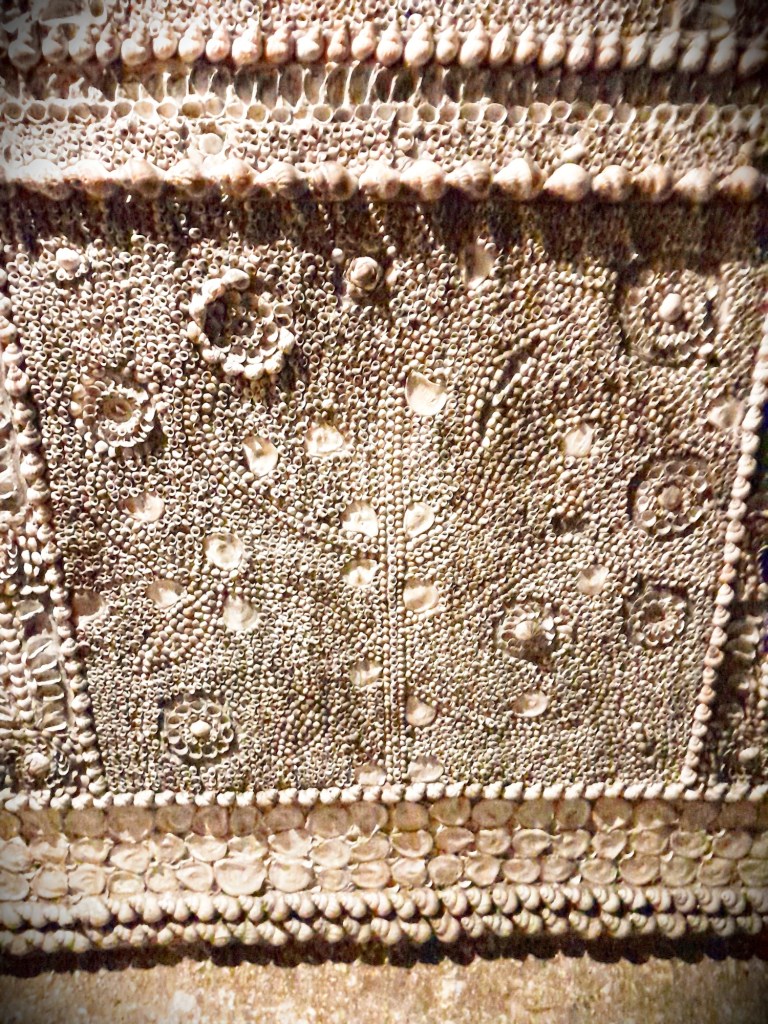
Seeing it depicted there on that wall amidst all the other designs, in this world of mystery and pagan symbolism, sparked a wave of conflicting emotions within me. What was the Tree of Life doing in that place? I had read about the Tree of Life in the articles I researched before our visit, but seeing it with my own eyes held a profound effect on me. In essence, the Tree of Life represents the core of Christian faith, the promise of eternal life, the gift of redemption and the unwavering love and provision of God. It was a tangible reminder of the enduring power of faith, a symbol of hope and renewal in the midst of the grotto’s enigmatic darkness.
This made me wonder me even further. The absence of Christian, Buddhist or Islamic symbols within the Shell Grotto is a curious omission that deepens its enigmatic nature. Were these symbols unknown to the creators or did they deliberately choose to exclude them? Could this subterranean sanctuary predate the established religions we know today, harking back to a time when humanity’s connection to the divine was expressed through more primal, universal symbols? Perhaps the grotto represents a melting pot of ancient beliefs, a place where diverse spiritual threads intertwined before the rise of established faiths. Or maybe it reflects purely pagan practices, not tied to a specific religion or belief system, but rather to a more instinctive reverence for nature and the cycles of life. The lack of these familiar religious symbols only adds to the grotto’s mystique, leaving us to ponder its origins and the beliefs of those who crafted this subterranean marvel.
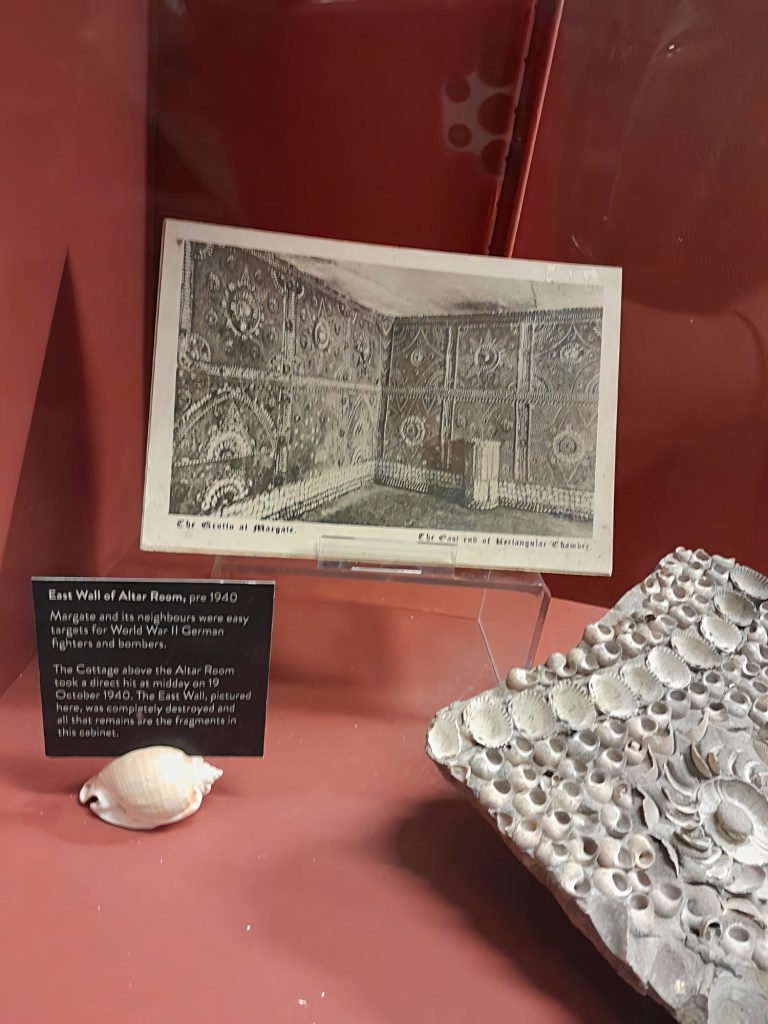
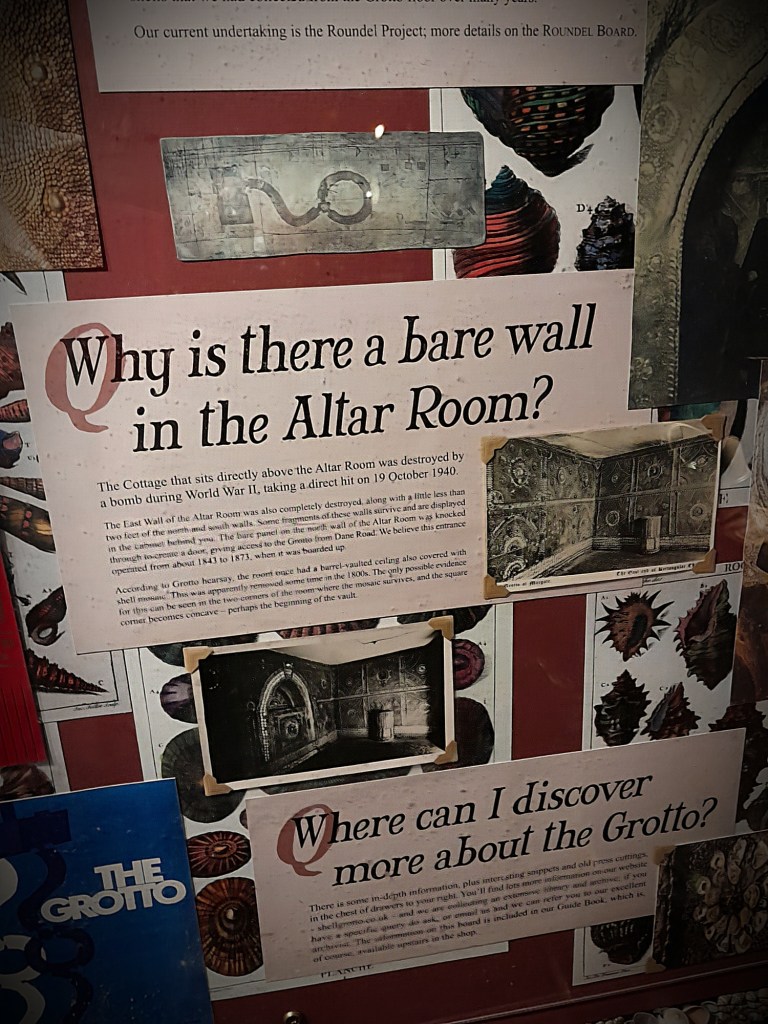
Turning our attention to the east wall of the Altar Chamber, we were met with a poignant reminder of the destructive power of war.
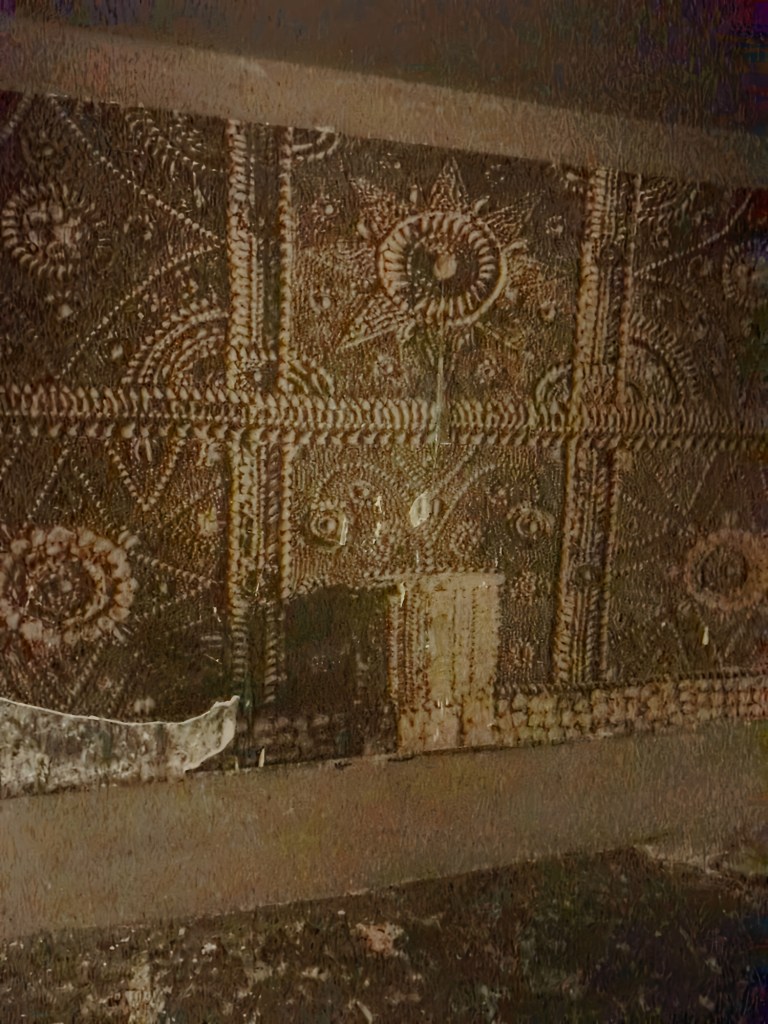
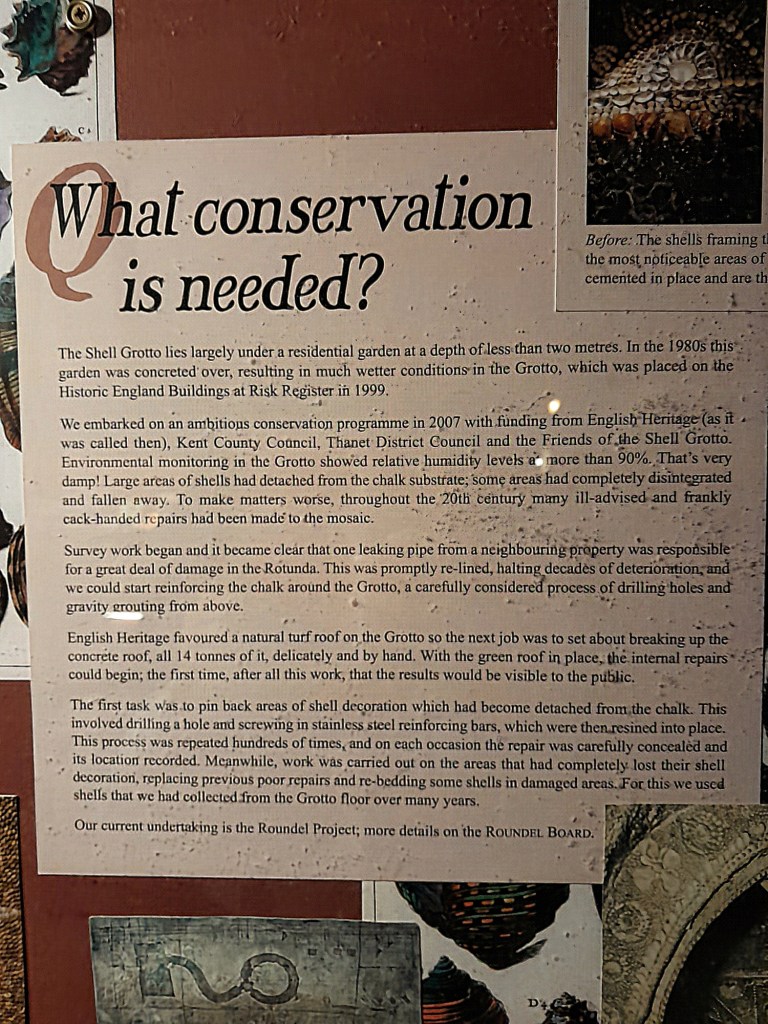
Unlike the other walls, which were adorned with intricate mosaics, this wall bore the scars of World War II. Large sections of the shell-encrusted surface were missing, leaving behind gaping holes and a sense of loss. It was a sobering reminder of the fragility of beauty and the enduring impact of conflict. Even in this hidden underground sanctuary, the echoes of war could be felt.
Emerging from the altar chamber, we felt a sense of awe and wonder, our minds buzzing with a myriad of questions and theories. The Shell Grotto,with its intricate mosaics, enigmatic symbols, and mysterious origins had captivated our imaginations.
As we made our way out of the grotto, we thanked the curator for her insights and bid farewell to this subterranean wonderland. But the mystery lingered, and I felt a strong desire to delve deeper into the grotto’s history. So, with Jaden in tow, I decided to make a detour to the local library. The library, with its hushed atmosphere and towering shelves filled with books, seemed the perfect place to uncover the secrets of the Shell Grotto. However, despite the promising environment, my search for information proved to be more challenging than I anticipated. To my disappointment, there was minimal documentation on the grotto’s history.
The librarian, sensing my frustration, after a diligent search, could only find one relevant article for me, tucked away in a book called ”Secret Margate” by Andy Bull. Eagerly, I flipped through its pages, hoping to find some hidden gems of knowledge. While the book did contain a few pages relating to the Shell Grotto, it mostly reiterated the familiar hypotheses I had already encountered in my research. The mystery, it seemed, remained stubbornly intact. The article primarily focused on the grotto’s discovery in 1838, when it was accidentally uncovered during garden renovations. It highlighted the intricate shell mosaics that adorn the walls and ceiling, emphasizing the significant amount of time and effort invested in its creation.
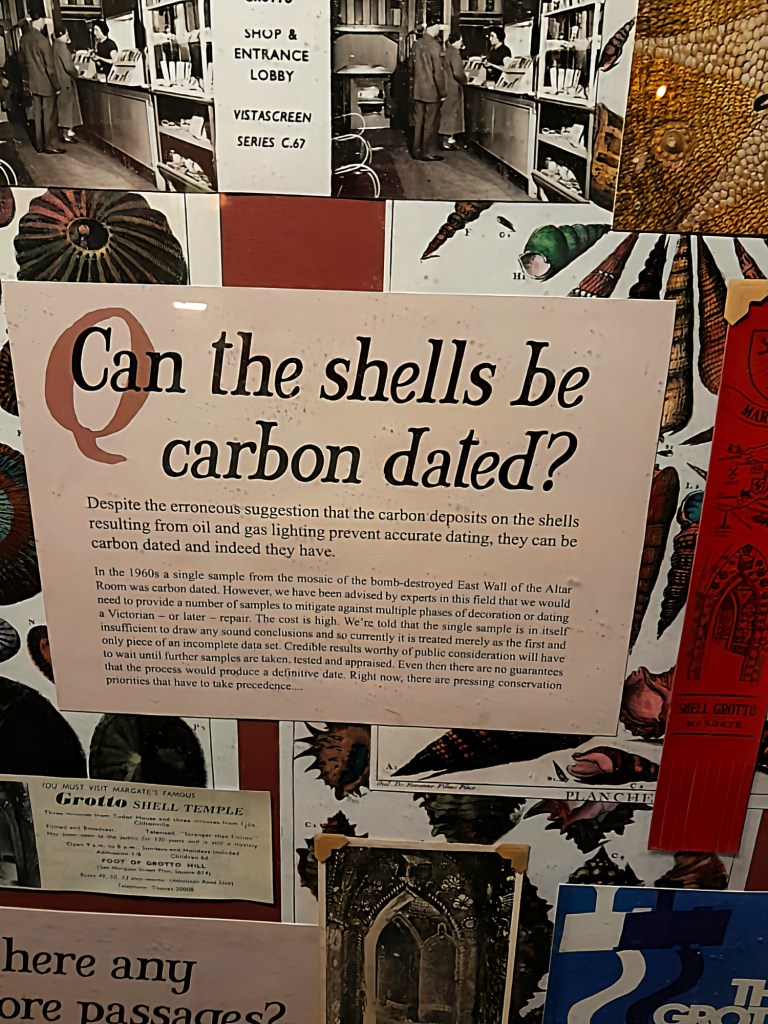
Despite the lack of concrete evidence, the article presented various theories about the grotto’s origins. Some speculate that it might be a remnant of a Roman temple or a medieval chapel, while others suggest it could be a folly created in the 18th or 19th century. The article relates to Patricia Marsh book ‘The Enigma of the Margate Shell Grotto’, affiliating the connection of the grotto to the Phoenicians, the ancient civilization known for their seafaring and trading activities. It’s suggested that the shell motifs might have symbolic significance within the Phoenician culture. The Shell Grotto continues to fascinate visitors with its beauty and mystery. While the article provided some intriguing clues, it ultimately left more questions than answers. It’s clear that the true story of the Shell Grotto remains hidden benath its intricate shell mosaics. Perhaps future research or new discoveries will shed light on this enigmatic underground chamber and reveal the secret it holds. Until then, the Shell Grotto will remain a captivating reminder of history’s mysteries.
But friends, our journey through the Shell Grotto doesn’t end here! The mysteries continue to unfold, and there’s much more to explore. I hope you have enjoyed this article! Subscribe to my website and follow along as we delve deeper into the grotto’s enigmatic symbols, uncover more hidden secrets, and attempt to unravel the enigma of its origins in Part 2. Stay tuned!


Leave a Reply